
Question 1
The adfuller() function in statsmodels is used to test:
Whether a time series has seasonal patterns
Whether a time series is stationary
Whether the data follows a normal distribution
Whether the variance of the data changes over time

The IIT Madras BS Machine Learning Practice (MLP) End Term paper sat on 21 Dec 2025, in the September 2025 term: 60 questions for 100 marks in 180 minutes. Every question is below with its answer. Take it as a timed mock test to be marked, or read it through first.
The adfuller() function in statsmodels is used to test:
Whether a time series has seasonal patterns
Whether a time series is stationary
Whether the data follows a normal distribution
Whether the variance of the data changes over time
Correct answer
Whether a time series is stationary
Identify the errors in the following code:
include_bias has to be kept true for polynomial features.
MinMaxScalar should be used for simple LinearRegression Models
model.fit_transform should be replace with model.fit
model.predict should be replaced with model.predict_proba
Correct answer
model.fit_transform should be replace with model.fit
What will typically happen if series_with_nans contains NaNs (null values) ?
statsmodels will automatically impute NaNs and fit silently.
fit() will raise an error or drop NaNs depending on the estimator; user should handle NaNs beforehand.
NaNs are treated as zeros.
The model will only use the NaN values to estimate variance.
Correct answer
fit() will raise an error or drop NaNs depending on the estimator; user should handle NaNs beforehand.
You are using a ColumnTransformer to preprocess a dataset before training a model:
What will be the shape of the transformed matrix X?
(3,2)
(3,3)
(3,4)
(4,3)
Correct answer
(3,3)
A newly launched movie has no ratings, but metadata such as genre, cast, and director is available. Which algorithm can still recommend it?
User-based Collaborative Filtering
Item-based Collaborative Filtering
Content-based filtering
Matrix factorization without regularization
Correct answer
Content-based filtering
We use classification report to evaluate our classification model:
Which of the following metrics are included in the classification report?
Accuracy
Mean Squared Error
F1 Score
Cross Entropy Loss
Recall
Correct answers
Accuracy
F1 Score
Recall
Performing singular value decomposition on a user-item matrix aims to:
Increase sparsity
Reduce dimensionality
Delete user history
Improve data imbalance
Correct answer
Reduce dimensionality
Consider the following cases for splitting train and test data for some real world dataset.
Which of the following hold true?
The selected samples(rows) in X_train will always be same for all the cases.
The selected samples(rows) in X_train will always be different for all the cases.
The selected samples(rows) in X_train will always be same for case 1 and case 3.
The selected samples(rows) in X_train will always be same for case 2 and case 3.
Correct answer
The selected samples(rows) in X_train will always be same for case 1 and case 3.
Which of the following can be used to evaluate the outputs of the KNNClassifier?
Negative Mean Absolute Error
Silhoutte Score
F1 Score
R2 Score
Inertia
Correct answer
F1 Score
What is the output of the following code? (Round to 2 decimals)
A written answer, not marked automatically.
What is the output of the following standard scaler transformation?
A written answer, not marked automatically.
A written answer, not marked automatically.
What is the value of recall score computed in the following code? (Enter upto 2 decimals)
A written answer, not marked automatically.
You are given the following DataFrame:
You want to perform the following imputation strategy: • Age → Replace missing values with the mean Age of each Department • Salary → Replace missing values with the median Salary of the entire column • Department → No imputation Which of the following code snippets correctly performs the above imputation?



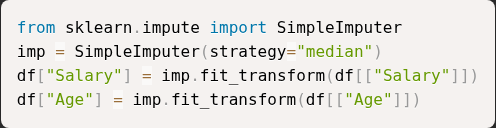
Correct answer
Which of the following algorithms don't get impacted by feature scaling?
LinearRegression
KNN
KMeans
DecisionTree
Correct answer
DecisionTree
You are given the following dataset and model:
What is the value of prediction after running this code?
A written answer, not marked automatically.
Consider the following data preprocessing code. What are the number of zero(s) in the transformed labels vector after applying label encoding?
A written answer, not marked automatically.
Select the correct statements from the following regarding GridSearchCV:
best_score parameter of grid search returns the mean cross validated score of all the cross validation folds.
best_score parameter of grid search returns the max cross validated score of all the cross validation folds.
If there are 2 parameter sets A and B with A having 3 values and B having 4 values the total parameter combinations grid search will try is 7.
If there are 2 parameter sets A and B with A having 3 values and B having 4 values the total parameter combinations grid search will try is 12.
No other scoring metric other than R2 score and mean_squared_error can be used as the scoring metric for GridSearchCV in case of regression problems.
Correct answers
best_score parameter of grid search returns the mean cross validated score of all the cross validation folds.
If there are 2 parameter sets A and B with A having 3 values and B having 4 values the total parameter combinations grid search will try is 12.
What does metric in the following code measure?
Accuracy
Precision
Recall
F1_Score
Correct answer
Recall
For the given above code calculate the sparcity (% of zeros) in one_hot. Enter your answer in percentage rounded to 2 decimals.
A written answer, not marked automatically.
Compute cosine similarity for the two items which have feature vectors as given below (rounded to 2 decimals).
A written answer, not marked automatically.
You are using make_blobs to generate synthetic data for clustering:
What will the output of the above clustering code?
One cluster containing all points.
It will raise an error since n_samples is not divisible by centers
Two clusters, but not necessarily equal-sized; distribution of samples per cluster may vary.
Two clusters with exactly 4 points each.
Correct answer
Two clusters with exactly 4 points each.
Identify the datatypes of the two datasets given below: (Assume all library imports are correctly done)
bunch , bunch
bunch , dataframe
dataframe , bunch
series, dataframe
Correct answer
bunch , dataframe
What does metric in the following code measure?
Accuracy
Precision
Recall
F1_Score
Correct answer
Precision
Which of the following statements about Hierarchical Agglomerative Clustering is TRUE?
It starts with all data points in a single cluster and recursively splits them.
It requires the number of clusters to be specified before training.
It repeatedly merges the two closest clusters until a stopping condition is met.
It updates cluster centroids after each merge.
Correct answer
It repeatedly merges the two closest clusters until a stopping condition is met.
You are training a RandomForestRegressor on a dataset with 20 features and 10,000 samples. Consider the following code:
Which of the following statements is TRUE about how this Random Forest model will behave?
With bootstrap=True, every tree sees the entire dataset, but the samples are shuffled randomly for each tree.
The forest will use all 20 features for each split, but only 5 trees out of the 200 will be trained on bootstrap samples.
Setting max_features=5 means only 5 trees out of 200 will use feature subsets, while the rest use all features.
Each tree will consider only 5 randomly chosen features when looking for the best split at every node.
Correct answer
Each tree will consider only 5 randomly chosen features when looking for the best split at every node.
You are using a ColumnTransformer to preprocess a dataset before training a model:
What will be the shape of the transformed matrix X?
(3,2)
(4,4)
(3,4)
(4,3)
Correct answer
(4,4)
What will be the output of the following code ? (Round to two decimals)
A written answer, not marked automatically.
A written answer, not marked automatically.
If pval = 0.03 for the following code, which of the option is correct at the 5% level?
Series is non-stationary.
Series is stationary.
The series has trend.
The series is noise.
Correct answer
Series is stationary.
You are given the following dataset and model:
What is the value of prediction after running this code?
A written answer, not marked automatically.
You are given the following four implementations of cosine similarity in NumPy. Which function correctly computes cosine similarity?

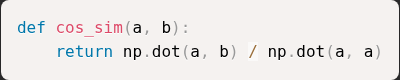


Correct answer
For the RandomForestClassifier select the correct pair(s) of parameter(s) and their explanation(s).
n_estimators – Number of trees in the RandomForestClassifier
max_depth – Maximum depth allowed for each decision tree
min_samples_leaf – Controls the maximum number of trees that will be created
bootstrap – Sets the number of features used for splitting at each node
Correct answers
n_estimators – Number of trees in the RandomForestClassifier
max_depth – Maximum depth allowed for each decision tree
Which of the following can be used to evaluate the outputs of the K-Means algorithm?
Negative Mean Absolute Error
Silhoutte Score
F1 Score
R2 Score
Inertia
Correct answers
Silhoutte Score
Inertia
What is the output of the following code?
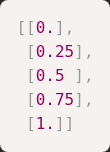
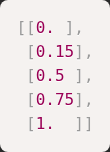
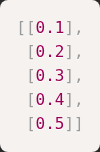
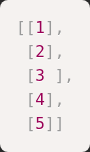
Correct answer
Select the correctly matched pairs of sklearn functions with the use of fit, fit_transform and transform.
Learning the weights of logistic regression model on training data - fit_transform
Creating a decision tree on the training data - fit
fitting MinMaxScaler on test data - fit_transform
fitting MinMaxScaler on train data - fit_transform
Correct answers
Creating a decision tree on the training data - fit
fitting MinMaxScaler on train data - fit_transform
Consider the following code snippet. Assume that all required libraries have been imported correctly.
A practitioner observes that each time the fit() method is called on clf, the model is trained from scratch and the parameters learned in the previous training call are discarded. Which of the following changes should be made so that the model continues training from the previously learned parameters when fit() is called again?
Set warm_start=True
Combine training data from all training sessions into a single dataset
Set retain_parameters=True
This behavior cannot be changed for Perceptron
Correct answer
Set warm_start=True
What is the output of the following code?
A written answer, not marked automatically.
Consider the following cases for splitting train and test data for some real world dataset.
Which of the following hold true?
The selected samples(rows) in X_train will always be same for all the cases.
The selected samples(rows) in X_train will always be different for all the cases.
The selected samples(rows) in X_train will always be different for case 1 and case 2.
The selected samples(rows) in X_train will always be different for case 1 and case 3.
Correct answer
The selected samples(rows) in X_train will always be different for case 1 and case 2.
Following is the code to tune the degree parameter of a polynomial regression model.
What should the blank space contain?
"degree"
"PolynomialFeatures_degree"
"sgd__degree"
"poly__degree"
Correct answer
"poly__degree"
You are performing hyperparameter tuning using GridSearchCV for a machine learning model. The following parameter grid is provided:
How many unique hyperparameter combinations will GridSearchCV evaluate in total?
A written answer, not marked automatically.
Which of the following is a hyper parameter?
intercept_ in LinearRegression
degree in PolynomialFeatures
n_neighbors in Ridge
min_samples_split in DecisionTreeClassifier
Correct answers
degree in PolynomialFeatures
min_samples_split in DecisionTreeClassifier
You are using make_blobs to generate synthetic data for clustering:
What will the output of the above clustering show?
One cluster containing all points.
It will raise an error since n_samples is not divisible by centers
Two clusters, but not necessarily equal-sized; distribution of samples per cluster may vary.
Two clusters with exactly 4 points each.
Correct answer
Two clusters with exactly 4 points each.
You are using statsmodels to forecast a time series. Which of the following represents the correct sequence of code to define an ARIMA model, train it, and view the results?
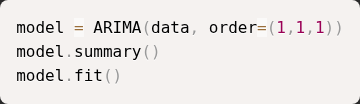
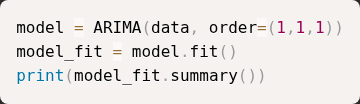
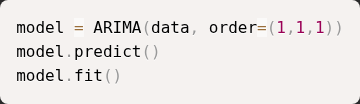
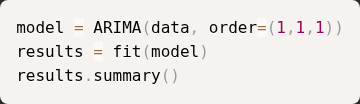
Correct answer
What does the following pandas code do ?
All rows where Age < 18, sorted by Marks, index unchanged.
Only rows where Marks > 60, sorted by Age, and index reset.
All rows sorted first by Marks, then by Age.
Drops the Age column and sorts remaining data.
Correct answer
Only rows where Marks > 60, sorted by Age, and index reset.
For a LinearRegression model with equation assume that the noise term . The model parameters satisfy the constraint A LinearRegression model is trained without intercept as shown below:
What is the value of ? Enter your answer rounded to three decimal places
A written answer, not marked automatically.
What does the parameter hidden_layer_sizes=(50, 30) represent in both MLPClassifier and MLPRegressor?
50 input features and 30 output units
Two hidden layers with 50 and 30 neurons respectively
50 epochs and 30 batches
50 samples per batch and 30 iterations
Correct answer
Two hidden layers with 50 and 30 neurons respectively
Which of the following is required for user-based collaborative filtering?
User–item interaction matrix
Item content features
User features (e.g. age, gender etc.)
Image embeddings
Correct answer
User–item interaction matrix
What is the role of the alpha=1.0 parameter in the given sklearn code to build a regression model?
It applies L1 regularization and sets some coefficients to zero.
It removes regularization completely and behaves like Linear Regression.
It adds L2 regularization that penalizes large coefficients to prevent overfitting.
It makes the model ignore the intercept term.
Correct answer
It adds L2 regularization that penalizes large coefficients to prevent overfitting.
Compute cosine similarity for the two items which have feature vectors as given below(rounded to 2 decimals).
A written answer, not marked automatically.
What is the output of the following code?
A written answer, not marked automatically.
Consider the following code snippet:
If the shape of X is , what will be the number of features in X_transformed?
A written answer, not marked automatically.
Which of the following is a hyper parameter?
"intercept_" in LinearRegression
"degree" in PolynomialFeatures
"n_neighbors" in KNeighborsClassifier
"max_depth" in DecisionTreeClassifier
Correct answers
"degree" in PolynomialFeatures
"n_neighbors" in KNeighborsClassifier
"max_depth" in DecisionTreeClassifier
Given the following code using BaggingClassifier with KNeighborsClassifier as the base estimator:
Which of the following statements is correct?
Above code uses bootstrapping to generate samples for each base classifier.
model will be tested on out of the bags samples.
Due to weights="distance", each base KNN classifier will treat all neighbors equally in terms of voting power.
The ensemble will consist of 3 base KNN classifiers.
None of these
Correct answer
None of these
Consider the following code snippet that trains a Decision Tree classifier using scikit-learn:
A node in the trained decision tree is split only if both of the following conditions are satisfied: • The node contains at least min_samples_split samples. • Each child node created after the split contains at least min_samples_leaf samples. Assume node (N) is a non-leaf node being considered for splitting. In which of the following cases will the split at node (N) be allowed?
Node (N) contains 15 samples. After splitting, the left child has 9 samples and the right child has 6 samples.
Node (N) contains 6 samples. After splitting, the left child has 4 samples and the right child has 2 samples.
Node (N) contains 12 samples. After splitting, the left child has 3 samples and the right child has 9 samples.
Node (N) contains 8 samples. After splitting, the left child has 4 samples and the right child has 4 samples.
Correct answers
Node (N) contains 15 samples. After splitting, the left child has 9 samples and the right child has 6 samples.
Node (N) contains 8 samples. After splitting, the left child has 4 samples and the right child has 4 samples.
Which of the following algorithms may get impacted by feature scaling?
LinearRegression
DecisionTree
SVM
NaiveBayes
Correct answers
LinearRegression
SVM
Consider the following ensemble model built using VotingClassifier with voting='soft':
How is the final prediction for a test sample obtained?
By selecting the most common predicted class.
By averaging predicted class probabilities.
By summing the predicted class labels.
By choosing the most accurate classifier.
Correct answer
By averaging predicted class probabilities.
Given below a y_train list which consists of coffee order's preference by the customers in a cafe.
MultiLabelBinarizer from sklearn library has been used to convert the y_train into numbers, so which of the following option matches with the output of the following code ?
[[1 0 1 0],[1 0 0 1],[0 1 0 1],[0 1 1 0]]
[[0 0],[1 0],[0 1],[1 1],[1 0],[0 0],[0 0],[0 0]]
[[1 0 1 0 0 1 0 0],[1 0 0 1 1 0 0 0]]
[[1 0][1 0],[1 0] [0 1],[0 1] [0 1],[0 1][1 0]]
Correct answer
[[1 0 1 0],[1 0 0 1],[0 1 0 1],[0 1 1 0]]
You are given a dataset where each row represents a customer using two numerical features. You apply K-means clustering with K=3 clusters using the following code:
What does the variable labels represent after the model is fitted?
The values of the input features used for clustering.
The cluster index assigned to each data point.
The total number of clusters formed.
The coordinates of the cluster centroids.
Correct answer
The cluster index assigned to each data point.
What could be the output for below code
['document' 'first' 'is' 'second' 'the' 'this']
{'this': 5, 'is': 2, 'the': 4, 'first': 1, 'document': 0, 'second': 3}
[5, 2, 4, 1, 0, 3]
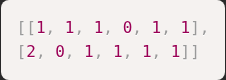
Correct answer
{'this': 5, 'is': 2, 'the': 4, 'first': 1, 'document': 0, 'second': 3}