
Question 1
Useful Data has been mentioned above.
This data attachment is just for a reference & not for an evaluation.
The IIT Madras BS Statistics for Data Science II (Stats 2) End Term paper sat on 14 Sept 2025, in the May 2025 term, set 1: 27 questions for 47 marks in 180 minutes. Every question is below with its answer. Take it as a timed mock test to be marked, or read it through first.
Useful Data has been mentioned above.
This data attachment is just for a reference & not for an evaluation.
Correct answer
Useful Data has been mentioned above.
A supermarket manager claims that the average billing time for customers is 12 minutes with a known standard deviation of 3.5 minutes. To verify this claim, a random sample of 49 customers was studied, showing an average billing time of 12.9 minutes. Let the null and alternative hypothesis be: ; . Find the P-value. Enter the answer correct to two decimal places.
A written answer, not marked automatically.
Consider the samples {1, 3, 4, 6, 2} taken from a Poisson Distribution with an unknown parameter . Using a Gamma(5, 8) prior, find the posterior distribution of .
Gamma
Gamma
Gamma
Gamma
Correct answer
Gamma
The joint probability density function of two continuous random variables and is given as,
Find the marginal density of .
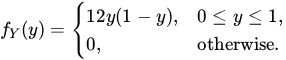
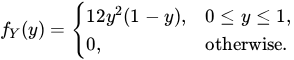
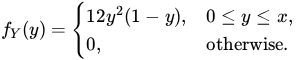
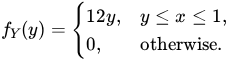
Correct answer
Let be a discrete random variable with the probability mass function
where
is an unknown parameter. Let be an estimator of from i.i.d , given as
Check whether is an unbiased estimator of , otherwise find an unbiased estimator of . Solution: Since we know that will be an unbiased estimator of if . Now,
Now, the values of and can be calculated as Now, substituting the values in equation(1), we get Hence, from equation(2) we can conclude that is an estimator of . Also, will be an unbiased estimator of . Consider the following options for the blanks.
Answer the given sub-questions. Note: Enter only the correct option number (e.g. 8) without any brackets or punctuation.
Enter the correct option number for .
A written answer, not marked automatically.
Let be a discrete random variable with the probability mass function
where
is an unknown parameter. Let be an estimator of from i.i.d , given as
Check whether is an unbiased estimator of , otherwise find an unbiased estimator of . Solution: Since we know that will be an unbiased estimator of if . Now,
Now, the values of and can be calculated as Now, substituting the values in equation(1), we get Hence, from equation(2) we can conclude that is an estimator of . Also, will be an unbiased estimator of . Consider the following options for the blanks.
Answer the given sub-questions. Note: Enter only the correct option number (e.g. 8) without any brackets or punctuation.
Enter the correct option number for .
A written answer, not marked automatically.
Let be a discrete random variable with the probability mass function
where
is an unknown parameter. Let be an estimator of from i.i.d , given as
Check whether is an unbiased estimator of , otherwise find an unbiased estimator of . Solution: Since we know that will be an unbiased estimator of if . Now,
Now, the values of and can be calculated as Now, substituting the values in equation(1), we get Hence, from equation(2) we can conclude that is an estimator of . Also, will be an unbiased estimator of . Consider the following options for the blanks.
Answer the given sub-questions. Note: Enter only the correct option number (e.g. 8) without any brackets or punctuation.
Enter the correct option number for .
A written answer, not marked automatically.
Let be a discrete random variable with the probability mass function
where
is an unknown parameter. Let be an estimator of from i.i.d , given as
Check whether is an unbiased estimator of , otherwise find an unbiased estimator of . Solution: Since we know that will be an unbiased estimator of if . Now,
Now, the values of and can be calculated as Now, substituting the values in equation(1), we get Hence, from equation(2) we can conclude that is an estimator of . Also, will be an unbiased estimator of . Consider the following options for the blanks.
Answer the given sub-questions. Note: Enter only the correct option number (e.g. 8) without any brackets or punctuation.
Enter the correct option number for .
A written answer, not marked automatically.
Let be a discrete random variable with the probability mass function
where
is an unknown parameter. Let be an estimator of from i.i.d , given as
Check whether is an unbiased estimator of , otherwise find an unbiased estimator of . Solution: Since we know that will be an unbiased estimator of if . Now,
Now, the values of and can be calculated as Now, substituting the values in equation(1), we get Hence, from equation(2) we can conclude that is an estimator of . Also, will be an unbiased estimator of . Consider the following options for the blanks.
Answer the given sub-questions. Note: Enter only the correct option number (e.g. 8) without any brackets or punctuation.
Enter the correct option number for .
A written answer, not marked automatically.
Let be a discrete random variable with the probability mass function
where
is an unknown parameter. Let be an estimator of from i.i.d , given as
Check whether is an unbiased estimator of , otherwise find an unbiased estimator of . Solution: Since we know that will be an unbiased estimator of if . Now,
Now, the values of and can be calculated as Now, substituting the values in equation(1), we get Hence, from equation(2) we can conclude that is an estimator of . Also, will be an unbiased estimator of . Consider the following options for the blanks.
Answer the given sub-questions. Note: Enter only the correct option number (e.g. 8) without any brackets or punctuation.
Enter the correct option number for .
A written answer, not marked automatically.
A nutrition company claims that the average protein content of its energy bars is 20 grams, with a known standard deviation of 4 grams. A sports academy suspects that the actual mean protein content may be less than 20 grams. To test the claim, the academy collects a random sample of 64 bars. The academy decides to reject the company’s claim if the mean protein content of the sample and accepts it otherwise. Assuming that the company’s claim is true, what is the probability that the academy rejects the claim?
A written answer, not marked automatically.
A laboratory is testing a new temperature sensor to check whether it provides more consistent readings than the old model. The lab records the temperature (in oC) from 5 repeated measurements using the new sensor: 10, 8, 2, 5, 15 The old temperature sensor has a known standard deviation of . Based on the above data, answer the given subquestions.
Compute the sample variance of the 5 temperature readings from the new sensor. Enter the answer correct to one decimal place.
A written answer, not marked automatically.
A laboratory is testing a new temperature sensor to check whether it provides more consistent readings than the old model. The lab records the temperature (in oC) from 5 repeated measurements using the new sensor: 10, 8, 2, 5, 15 The old temperature sensor has a known standard deviation of . Based on the above data, answer the given subquestions.
At significance level, determine whether the new sensor has less variability than the old sensor.
The new sensor does not show less variability than the old sensor.
The new sensor has less variability than the old sensor.
Correct answer
The new sensor does not show less variability than the old sensor.
A factory manufactures light bulbs, and each bulb has a probability of being defective. To estimate this probability using Bayesian methods, assume the prior distribution of to be Beta(3, 3). A quality inspector tests 12 independent bulbs. If 5 bulbs are found to be defective, answer the given subquestions.
Determine the posterior distribution of .
Beta
Beta
Beta
Beta
Correct answer
Beta
A factory manufactures light bulbs, and each bulb has a probability of being defective. To estimate this probability using Bayesian methods, assume the prior distribution of to be Beta(3, 3). A quality inspector tests 12 independent bulbs. If 5 bulbs are found to be defective, answer the given subquestions.
Using the posterior distribution, calculate the posterior mean of . Enter the answer correct to two decimal places.
A written answer, not marked automatically.
The probability density function of a continuous random variable is given by
Based on the above data, answer the given subquestions.
Let be the CDF of . Calculate the value of . Enter the answer correct to two decimal places.
A written answer, not marked automatically.
The probability density function of a continuous random variable is given by
Based on the above data, answer the given subquestions.
Find the expected value of .


Correct answer
The joint PMF of two discrete random variables and is given in the following table:
Based on the above data, answer the given subquestions.
What is the value of ?
0.01
0.10
0.70
0.30
Correct answer
0.10
The joint PMF of two discrete random variables and is given in the following table:
Based on the above data, answer the given subquestions.
Find the value of . Enter the answer correct to two decimal places.
A written answer, not marked automatically.
Let the random variable represent the number of issues resolved during a customer support call. The probability mass function of is given by
where
. A random sample of five customer ratings is {1, 2, 2, 3, 2}. Based on the above data, answer the given subquestions.
Find the method of moments estimate of for the given sample. Enter the answer correct to two decimal places.
A written answer, not marked automatically.
Let the random variable represent the number of issues resolved during a customer support call. The probability mass function of is given by
where
. A random sample of five customer ratings is {1, 2, 2, 3, 2}. Based on the above data, answer the given subquestions.
The service policy requires that the average number of issues resolved per call must be at least 1.5. Based on the estimated value of , determine whether this requirement is satisfied.
The requirement is satisfied.
The requirement is not satisfied.
Correct answer
The requirement is satisfied.
Let be a discrete random variable with the probability mass function
where
is an unknown parameter. Let be an estimator of from i.i.d , given as
Check whether is an unbiased estimator of , otherwise find an unbiased estimator of . Solution: Since we know that will be an unbiased estimator of if . Now,
Now, the values of and can be calculated as Now, substituting the values in equation(1), we get Hence, from equation(2) we can conclude that is an estimator of . Also, will be an unbiased estimator of . Consider the following options for the blanks.
Answer the given sub-questions. Note: Enter only the correct option number (e.g. 8) without any brackets or punctuation.
A written answer, not marked automatically.
A laboratory is testing a new temperature sensor to check whether it provides more consistent readings than the old model. The lab records the temperature (in oC) from 5 repeated measurements using the new sensor: 10, 8, 2, 5, 15 The old temperature sensor has a known standard deviation of . Based on the above data, answer the given subquestions.
A written answer, not marked automatically.
A factory manufactures light bulbs, and each bulb has a probability of being defective. To estimate this probability using Bayesian methods, assume the prior distribution of to be Beta(3, 3). A quality inspector tests 12 independent bulbs. If 5 bulbs are found to be defective, answer the given subquestions.
A written answer, not marked automatically.
The probability density function of a continuous random variable is given by
Based on the above data, answer the given subquestions.
A written answer, not marked automatically.
The joint PMF of two discrete random variables and is given in the following table:
Based on the above data, answer the given subquestions.
A written answer, not marked automatically.
Let the random variable represent the number of issues resolved during a customer support call. The probability mass function of is given by
where
. A random sample of five customer ratings is {1, 2, 2, 3, 2}. Based on the above data, answer the given subquestions.
A written answer, not marked automatically.