uiz Space

January 2026 term · Database Management Systems · BSCS2001

Database Management Systems End Term: 10 May 2026, Set 1 (January 2026 term)

The IIT Madras BS Database Management Systems (DBMS) End Term paper sat on 10 May 2026, in the January 2026 term, set 1: 20 questions for 50 marks in 180 minutes. Every question is below with its answer. Take it as a timed mock test to be marked, or read it through first.

Questions
20
Marks
50
Duration
180 min
MCQ
8
MSQ
6
Written
6

Updated

Official paper: Database Management Systems 06 May 26 · No negative marking.

Question 1

+3 marksOne correct option

Consider a B-tree index to be built on the attribute EmployeeID of a table Employees, with the following properties: • The length of the attribute EmployeeID is 16 bytes. • The size of each child pointer is 8 bytes. • The size of each record pointer is 8 bytes. • The size of each disk block is 488 bytes. With the given information, what is the best choice for the order of the non-leaf nodes of the B-tree?

  1. A

    14

  2. B

    15

  3. C

    16

  4. D

    17

Show answer

Correct answer

  • C

    16

Question 2

+3 marksOne correct option

Consider the table BandRecords as given below:

Let us create two different bitmap indices, one on the Tour attribute and the other on the Genre attribute. Which of the following options will give the correct result if we want to find all bands performing in 'RetroLive' and having the genre 'Rock'? Note: Options are in the form of Tour (operation) Genre

Consider the table BandRecords as given below:
  1. A

    10000100 AND 00100100

  2. B

    00000101 OR 11001001

  3. C

    00001001 AND 11001001

  4. D

    00001001 OR 00100100

Show answer

Correct answer

  • C

    00001001 AND 11001001

Question 3

+3 marksOne correct option

Consider the relational schemas Student, Course and Enrolled:

Now consider the following SQL query:

The query returns:

Consider the relational schemas Student, Course and Enrolled:
  1. A

    Names of students who failed in all courses

  2. B

    Names of students who failed in at least one course

  3. C

    Names of students who have not failed in any course

  4. D

    Names of students who are enrolled in all courses

Show answer

Correct answer

  • C

    Names of students who have not failed in any course

Question 4

+3 marksOne or more correct options

Consider the hash functions given below. • • • • Identify the hash function(s) that can generate unique hash values for the following search key values: .

Select all that apply.

  1. A

    —

  2. B

    —

  3. C

    —

  4. D

    —

Show answer

Correct answers

  • A

    —

  • C

    —

Question 5

+3 marksOne or more correct options

Consider the definition of the table Products:

The following sequence of queries is executed on this table:

Which of the following results in an invalid operation on the table Products?

Consider the definition of the table Products:

Select all that apply.

  1. A

    —

  2. B

    —

  3. C

    —

  4. D

    —

Show answer

Correct answers

  • A

    —

  • B

    —

Question 6

+3 marksOne or more correct options

Schedule S is as given:

Which of the following options is/are correct?

Schedule S is as given:

Select all that apply.

  1. A

    Schedule S is not conflict serializable.

  2. B

    Schedule S can be two-phase lockable.

  3. C

    Two phase lockable schedules are always serializable.

  4. D

    Schedule S is not two-phase lockable.

Show answer

Correct answers

  • A

    Schedule S is not conflict serializable.

  • C

    Two phase lockable schedules are always serializable.

  • D

    Schedule S is not two-phase lockable.

Question 7

+3 marksOne or more correct options

Consider a relation schema T(A,B,C,D,E,F) and the set of functional dependencies, F= {A → BC, C → D, D → C, B → E, E → F}. This schema is decomposed into two relations T1(A,B,C,E) and T2(A,C,D,F). Consider the following statements given below regarding the decomposition of T1 and T2. Choose the correct option(s).

Select all that apply.

  1. A

    The decomposition of T into T1 and T2 is dependency preserving.

  2. B

    The decomposition of T into T1 and T2 is lossless.

  3. C

    The schema T1 is in 2NF.

  4. D

    The schema T2 is in 3NF.

Show answer

Correct answers

  • B

    The decomposition of T into T1 and T2 is lossless.

  • C

    The schema T1 is in 2NF.

Question 8

+2 marksOne correct option

Consider the following monthly backup schedule used by a company:

If a failure occurs on the 24th day of the month after the backup for the day has been completed, how many backup sets have to be loaded for a full recovery?

Consider the following monthly backup schedule used by a company:
  1. A

    10

  2. B

    11

  3. C

    9

  4. D

    8

Show answer

Correct answer

  • A

    10

Question 9

+2 marksOne correct option

Consider the instance of a relation V. Which among the following functional dependency set(s) can be inferred from the given information?

Consider the instance of a relation V. Which among the following functional dependency set(s) can be inferred from the g
  1. A

    {P → R, R → S, P Q → R, S → P }

  2. B

    {R → S, P Q → S, Q → P, P → S}

  3. C

    {P → S, R → S, P Q → R, S → Q}

  4. D

    {R → S, P Q → S, P → S, Q → R}

Show answer

Correct answer

  • B

    {R → S, P Q → S, Q → P, P → S}

Question 10

+2 marksOne correct option

Consider the following relational schema:

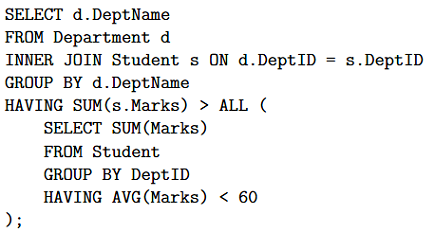
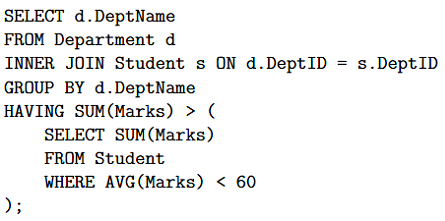
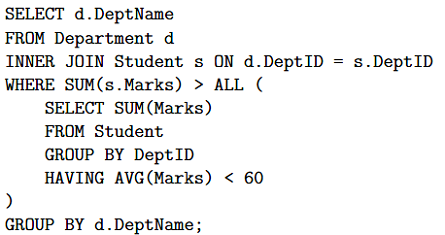
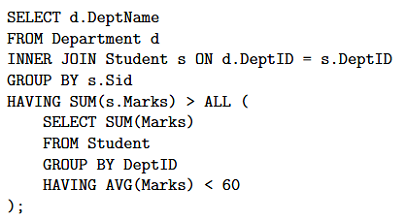
Choose the correct SQL query to find the names of departments where the total marks of students is greater than the total marks in any department where the average marks is less than 60.

Consider the following relational schema:
  1. A
    Figure from the original question paper
  2. B
    Figure from the original question paper
  3. C
    Figure from the original question paper
  4. D
    Figure from the original question paper
Show answer

Correct answer

  • A
    Figure from the original question paper

Question 11

+2 marksOne correct option

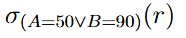
Choose the relational algebra expression that is equivalent to the following tuple calculus expression:

  1. A
    Figure from the original question paper
  2. B

    —

  3. C
    Figure from the original question paper
  4. D
    Figure from the original question paper
Show answer

Correct answer

  • C
    Figure from the original question paper

Question 12

+2 marksOne correct option

Consider a B+ tree index built on the key attribute of a data file having 62,50,000 records. Let the order of the B+ tree be 50. Find out the maximum number of nodes to be accessed to search a key from the given B+ tree.

  1. A

    7

  2. B

    23

  3. C

    4

  4. D

    5

Show answer

Correct answer

  • D

    5

Question 13

+1 markOne or more correct options

Choose the correct statement(s).

Select all that apply.

  1. A

    RAID 2 uses designated drive for parity.

  2. B

    RAID Level-1 does not stripe the data over different disks.

  3. C

    RAID 3 consists of bit-level striping with dedicated parity.

  4. D

    RAID 4 has a striping unit of a disk block instead of a single bit, as in RAID 3

Show answer

Correct answers

  • A

    RAID 2 uses designated drive for parity.

  • B

    RAID Level-1 does not stripe the data over different disks.

  • D

    RAID 4 has a striping unit of a disk block instead of a single bit, as in RAID 3

Question 14

+2 marksOne or more correct options

Consider the ER Diagram as shown below:

Which of the following statement(s) is/are correct?

Consider the ER Diagram as shown below:

Select all that apply.

  1. A

    Every item must be produced by some company

  2. B

    Minimum number of tables required to convert this ERD to Relation Model is 5

  3. C

    An item can be ordered by at most one customer

  4. D

    There may exist a company which has not produced any items

Show answer

Correct answers

  • A

    Every item must be produced by some company

  • B

    Minimum number of tables required to convert this ERD to Relation Model is 5

Question 15

+3 marksWritten answer

Consider the given log records at an instance of time:

Suppose there is a system crash after the last log record. What will be the value of the expression (B-A)+(C-D), based on the values stored on the disk at that point?

Consider the given log records at an instance of time:
Show answer

A written answer, not marked automatically.

Question 16

+3 marksWritten answer

Consider you have a file in your hard disk of size 900 KB. Seek time of your hard disk read head is 5 ms and rotational speed is 30,000 rpm. The disk has 250 sectors per track and 512 bytes per sector. Considering the fact that the file data is stored in consecutive sectors, how much time will be required to read the whole file after a read request is made? (answer in milliseconds and calculate upto one decimal place)

Show answer

A written answer, not marked automatically.

Question 17

+3 marksWritten answer

Consider a system using the Most Recently Used (MRU) page replacement policy. The system has a main memory buffer with 3 slots, and the page reference sequence is as follows: 2, 1, 3, 2, 4, 2, 1, 5, 2, 1, 4 Calculate the total number of page hits during this sequence.

Show answer

A written answer, not marked automatically.

Question 18

+3 marksWritten answer

Consider the following schedule S with five transactions T1, T2, T3, T4, T5: Where, Ri(X) denotes a read operation by transaction Ti on a data item X, and Wi(X) denotes a write operation by transaction Ti on a data item X. What is the possible number of conflict serializable schedules of the above schedule S?

Show answer

A written answer, not marked automatically.

Question 19

+2 marksWritten answer

Consider the relation R(A, B, C, D, E, F) and the following functional dependencies set F = {AB → C, C → D, D → E, E → F} Find the total number of super keys of R.

Show answer

A written answer, not marked automatically.

Question 20

+2 marksWritten answer

Consider a block nested-loop join for the two relations students and enrollments:

Assuming the worst-case memory availability and considering students as the outer relation, what is the total number of block transfers required?

Consider a block nested-loop join for the two relations students and enrollments:
Show answer

A written answer, not marked automatically.