Quiz Space

September 2024 term · Computational Thinking · BSCS1001

Computational Thinking (CT) Quiz 2: 1 December 2024, Set 1 (September 2024 term)

The IIT Madras BS Computational Thinking (Computational Thinking (CT)) Quiz 2 paper sat on 1 Dec 2024, in the September 2024 term, set 1: 17 questions for 55 marks in 120 minutes. Every question is below with its answer. Take it as a timed mock test to be marked, or read it through first.

Questions
17
Marks
55
Duration
120 min
MCQ
11
MSQ
2
Written
4

Updated

Official paper: IIT M FOUNDATION AN EXAM QDF4 01 Dec · No negative marking.

Question 1

+1 markOne correct option

THIS IS QUESTION PAPER FOR THE SUBJECT "FOUNDATION LEVEL : COMPUTATIONAL THINKING (COMPUTER BASED EXAM)" ARE YOU SURE YOU HAVE TO WRITE EXAM FOR THIS SUBJECT? CROSS CHECK YOUR HALL TICKET TO CONFIRM THE SUBJECTS TO BE WRITTEN. (IF IT IS NOT THE CORRECT SUBJECT, PLS CHECK THE SECTION AT THE TOP FOR THE SUBJECTS REGISTERED BY YOU)

  1. A

    YES

  2. B

    NO

Show answer

Correct answer

  • A

    YES

Question 2

+1 markOne correct option
Figure from the original question paper
  1. A

    Useful Data has been mentioned above.

  2. B

    This data attachment is just for a reference & not for an evaluation.

Show answer

Correct answer

  • A

    Useful Data has been mentioned above.

Question 3

+4 marksOne correct option
Figure from the original question paper
  1. A
    Figure from the original question paper
  2. B
    Figure from the original question paper
  3. C
    Figure from the original question paper
  4. D
    Figure from the original question paper
Show answer

Correct answer

  • C
    Figure from the original question paper

Question 4

+4 marksOne correct option
Figure from the original question paper
  1. A

    [2, 2, 6, 6, 7, 7]

  2. B

    [2, 6, 7]

  3. C

    [2, 6, 7, 8, 3]

  4. D

    [2, 3, 6, 7, 8]

Show answer

Correct answer

  • C

    [2, 6, 7, 8, 3]

Question 5

+5 marksOne correct option
Figure from the original question paper
  1. A

    [-2, -1, -5]

  2. B

    [3, 4, 7]

  3. C

    [14]

  4. D

    [-8]

Show answer

Correct answer

  • B

    [3, 4, 7]

Question 6

+4 marksOne or more correct options
Figure from the original question paper

Select all that apply.

  1. A

    Length(A) >= Length(B) will always be true.

  2. B

    A represent the serial numbers of words having letter count less than 5.

  3. C

    B represent the serial numbers of all nouns with letter counts less than 5.

  4. D

    B represent the serial numbers of all nouns.

Show answer

Correct answers

  • A

    Length(A) >= Length(B) will always be true.

  • B

    A represent the serial numbers of words having letter count less than 5.

  • C

    B represent the serial numbers of all nouns with letter counts less than 5.

Question 7

+4 marksOne or more correct options

We have a non-empty list, Publisher that stores the publisher name in each card from the "Library" dataset, sorted in alphabetical order. This results in many duplicates. The following procedure attempts to extract the unique list of publishers, while preserving the sorted order. The pseudocode may have mistakes. Identify all such mistakes (if any). It is a Multiple Select Question.


We have a non-empty list, Publisher that stores the publisher name in each card from the "Library" dataset, sorted in alphabetical order. This results in many duplicates. The following procedure attempts to extract the unique list of publishers, while preserving the sorted order. The pseudocode may have mistakes. Identify all such mistakes (if any). It is a Multiple Select Question.

We have a non-empty list, Publisher that stores the publisher name in each card from the "Library" dataset, sorted in al

Select all that apply.

  1. A

    Error in line 2

  2. B

    Error in line 4

  3. C

    Error in line 5

  4. D

    Error in line 7

  5. E

    No error

Show answer

Correct answers

  • A

    Error in line 2

  • C

    Error in line 5

Question 8

+4 marksWritten answer
Figure from the original question paper
Show answer

A written answer, not marked automatically.

Question 9

+3 marksOne correct option

The following pseudocode is executed using the "Words" dataset.

The following pseudocode is executed using the "Words" dataset. Answer the given subquestions.

The following pseudocode is executed using the "Words" dataset.

What will count represent at the end of the execution if the missing code is filled by below code?

What will count represent at the end of the execution if the missing code is filled by below code?

What will count represent at the end of the execution if the missing code is filled by below code?
  1. A

    Total number of nouns in the dataset

  2. B

    Number of sentences which do not end with a noun

  3. C

    Number of sentences having at least one noun

  4. D

    Number of sentences which end with a noun

Show answer

Correct answer

  • B

    Number of sentences which do not end with a noun

Question 10

+4 marksOne correct option

The following pseudocode is executed using the "Words" dataset.

The following pseudocode is executed using the "Words" dataset. Answer the given subquestions.

The following pseudocode is executed using the "Words" dataset.

What will count represent at the end of the execution if the missing code is filled by below code?

What will count represent at the end of the execution if the missing code is filled by below code?

What will count represent at the end of the execution if the missing code is filled by below code?
  1. A

    Total number of verbs in the dataset

  2. B

    Number of sentences which start with a verb

  3. C

    Number of sentences which do not start with a verb

  4. D

    Number of sentences which end with a verb

Show answer

Correct answer

  • C

    Number of sentences which do not start with a verb

Question 11

+4 marksOne correct option

The following pseudocode is executed using the "Olympics" dataset.

The following pseudocode is executed using the "Olympics" dataset. Based on the above data, answer the given subquestions.

The following pseudocode is executed using the "Olympics" dataset.

What will Dict store at the end of execution of the given pseudocode?

  1. A

    Number of medals of each type

  2. B

    Number of each type of medal won by each player

  3. C

    Number of medals won by each player

  4. D

    Number of players who have won the medal

Show answer

Correct answer

  • B

    Number of each type of medal won by each player

Question 12

+4 marksOne correct option

The following pseudocode is executed using the "Olympics" dataset.

The following pseudocode is executed using the "Olympics" dataset. Based on the above data, answer the given subquestions.

The following pseudocode is executed using the "Olympics" dataset.

What will list store at the end of execution of the pseudocode?

  1. A

    Names of all the players who have won least number of medals.

  2. B

    Name of a player who has won the highest number of medals.

  3. C

    Name of a player who has won the least number of medals.

  4. D

    Names of all the players who have won highest number of medals.

Show answer

Correct answer

  • D

    Names of all the players who have won highest number of medals.

Question 13

+5 marksOne correct option

Consider the following pseudocodes which are executed on "Words" datasets and answer the given subquestions

Consider the following pseudocodes which are executed on "Words" datasets and answer the given subquestions

Consider the following pseudocodes which are executed on "Words" datasets and answer the given subquestions

Which of the following statements is/are correct? (MSQ)

  1. A

    In Pseudocode 2, count represents the number of sentences containing atleast 10 distinct letters.

  2. B

    In Pseudocode 1, count represents the number of sentences containing atleast 10 distinct letters.

  3. C

    In Pseudocode 1, count represents the number of sentences containing atleast 10 letters.

  4. D

    In Pseudocode 2, count represents the number of sentences containing atleast 10 letters.

Show answer

Correct answer

  • B

    In Pseudocode 1, count represents the number of sentences containing atleast 10 distinct letters.

Question 14

+5 marksOne correct option

Consider the following pseudocodes which are executed on "Words" datasets and answer the given subquestions

Consider the following pseudocodes which are executed on "Words" datasets and answer the given subquestions

Consider the following pseudocodes which are executed on "Words" datasets and answer the given subquestions

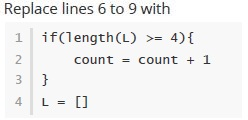
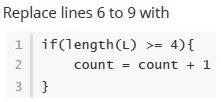
What changes/modification should we make to Pseudocode 2, so that, at the end of execution, count represents the number of words having at least 4 distinct letters in the datasets?

  1. A
    Figure from the original question paper
  2. B
    Figure from the original question paper
  3. C
    Figure from the original question paper
  4. D
    Figure from the original question paper
Show answer

Correct answer

  • B
    Figure from the original question paper

Question 15

+1 markWritten answer

The following pseudocode is executed using the "Words" dataset.

The following pseudocode is executed using the "Words" dataset. Answer the given subquestions.

The following pseudocode is executed using the "Words" dataset.
Show answer

A written answer, not marked automatically.

Question 16

+1 markWritten answer

The following pseudocode is executed using the "Olympics" dataset.

The following pseudocode is executed using the "Olympics" dataset. Based on the above data, answer the given subquestions.

The following pseudocode is executed using the "Olympics" dataset.
Show answer

A written answer, not marked automatically.

Question 17

+1 markWritten answer

Consider the following pseudocodes which are executed on "Words" datasets and answer the given subquestions

Consider the following pseudocodes which are executed on "Words" datasets and answer the given subquestions

Consider the following pseudocodes which are executed on "Words" datasets and answer the given subquestions
Show answer

A written answer, not marked automatically.