
Question 1
State whether the following statement is true or false. The decision boundary learned by a neural network is always non-linear.
True
False

The IIT Madras BS Deep Learning (Deep Learning) Quiz 1 paper sat on 19 Jul 2026, in the May 2026 term: 20 questions for 52 marks in 120 minutes. Every question is below with its answer. Take it as a timed mock test to be marked, or read it through first.
State whether the following statement is true or false. The decision boundary learned by a neural network is always non-linear.
True
False
Correct answer
False
Consider the following two statements and select the correct options. Statement I: A single MP neuron can be used to represent all linearly separable Boolean functions. Statement II: Every linearly separable boolean function can be represented using at least one MP neuron.
Only Statement I is true
Only Statement II is true
Both the statements are true.
None of the statements are true.
Correct answer
Only Statement II is true
Two runs of gradient descent on from the same starting point produce Graph X and Graph Y using two learning rates:
Which among the following options could be correct?
X uses , Y uses
X uses , Y uses
Correct answer
X uses , Y uses
The loss function is minimized starting at with using four methods: Vanilla Gradient Descent ( ), and momentum based gradient descent with .
Match each curve to its value:
S: , T: , U: , V:
S: , T: , U: , V:
S: , T: , U: , V:
S: , T: , U: , V:
Correct answer
S: , T: , U: , V:
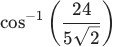
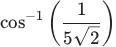
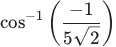
A perceptron is being trained on a 2D dataset using the Perceptron Learning Algorithm. The current weight vector
For a misclassified training example
with true label , the perceptron update rule with learning rate is applied: Let denote the angle between and . Which of the following is equal to ?
—
Correct answer
Which of the following statements are TRUE about training neural networks?
Stochastic gradient descent (batch size ) computes the true gradient of the total loss function at each step.
In mini-batch gradient descent with batch size on a dataset of points, one epoch consists of parameter updates.
Momentum-based gradient descent can overshoot a narrow valley because accumulated velocity carries the parameters past the minimum.
In vanilla (batch) gradient descent, each step is guaranteed to decrease the loss for a sufficiently small learning rate on a smooth loss function.
Correct answers
In mini-batch gradient descent with batch size on a dataset of points, one epoch consists of parameter updates.
Momentum-based gradient descent can overshoot a narrow valley because accumulated velocity carries the parameters past the minimum.
In vanilla (batch) gradient descent, each step is guaranteed to decrease the loss for a sufficiently small learning rate on a smooth loss function.
Consider a hidden layer with neurons, all initialized with identical weight vectors and identical bias . The activation function is sigmoid. Which of the following are TRUE?
After one gradient descent step, the neurons will have different weights.
For any input , all neurons will produce the same output.
During backpropagation, the gradients of all neurons are always zero because their weights are identical.
This layer is functionally equivalent to having a single neuron, because all neurons compute the same function.
Correct answers
For any input , all neurons will produce the same output.
This layer is functionally equivalent to having a single neuron, because all neurons compute the same function.
Consider an MP neuron with three inputs Inputs and are excitatory, while is inhibitory. The threshold of the neuron is 2.The neuron fires (outputs 1) if: ● the inhibitory input is inactive, and ● the sum of excitatory inputs is at least the threshold. Which of the following statements are correct?
For input , the neuron outputs 1.
For input , the neuron outputs 1.
For input , the neuron outputs 0.
Increasing the threshold from 2 to 3 would not change the output of the neuron for any input combination.
Correct answers
For input , the neuron outputs 1.
For input , the neuron outputs 0.
Consider a perceptron with initial parameters
The perceptron predicts class if and class otherwise. Whenever a training example is misclassified, where , the perceptron updates its parameters as The following training examples are processed once in the order
Which of the following statements are correct?
The first weight update occurs after processing point .
The second weight update occurs after processing point .
The final bias equals .
The perceptron performs exactly two weight updates.
Correct answers
The first weight update occurs after processing point .
The perceptron performs exactly two weight updates.
Which of the following statements regarding perceptrons and sigmoid neurons are correct?
The output of a perceptron changes abruptly when the weighted sum of inputs crosses the threshold, whereas the output of a sigmoid neuron changes smoothly.
The sigmoid activation function is differentiable, making it suitable for gradient-based learning algorithms.
By choosing sufficiently large weights, the output of a sigmoid neuron can closely approximate the output of a perceptron.
A multilayer network of perceptrons with a single hidden layer can represent any Boolean function exactly.
A multilayer network of sigmoid neurons with a single hidden layer can approximate any continuous function to any desired precision, provided enough hidden neurons are available.
A single sigmoid neuron can represent every non-linear decision boundary in .
Correct answers
The output of a perceptron changes abruptly when the weighted sum of inputs crosses the threshold, whereas the output of a sigmoid neuron changes smoothly.
The sigmoid activation function is differentiable, making it suitable for gradient-based learning algorithms.
By choosing sufficiently large weights, the output of a sigmoid neuron can closely approximate the output of a perceptron.
A multilayer network of perceptrons with a single hidden layer can represent any Boolean function exactly.
A multilayer network of sigmoid neurons with a single hidden layer can approximate any continuous function to any desired precision, provided enough hidden neurons are available.
Which of the following statements are true regarding the sigmoid function and its Taylor series approximation? Let
be the sigmoid activation function.
Using the first-order Taylor approximation , the sigmoid function near can be approximated as .
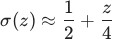
The derivative of the sigmoid function at is .

The first-order Taylor approximation implies that the sigmoid function is exactly linear for all values of .
As becomes very large, the linear approximation obtained from the Taylor series becomes increasingly inaccurate.
The smooth differentiability of the sigmoid function enables the use of gradient-based learning algorithms, unlike the hard-threshold perceptron.
Correct answers
Using the first-order Taylor approximation , the sigmoid function near can be approximated as .
The derivative of the sigmoid function at is .
As becomes very large, the linear approximation obtained from the Taylor series becomes increasingly inaccurate.
The smooth differentiability of the sigmoid function enables the use of gradient-based learning algorithms, unlike the hard-threshold perceptron.
Consider a regression problem of predicting the price of a house using two features: Overall quality , living area (sq. ft) . A simple feed forward neural network is used. It has three layers: ● The input layer consisting of the two features . ● A hidden layer consisting of three sigmoid (logistic) neurons with weights and biases . ● Output layer with a single linear neuron that outputs the predicted house value with weights and bias .
Suppose we start the Gradient Descent algorithm by setting all the weights equal to 0, equal to 100, and the biases equal to 0. What does the initial network give for the price of a house with overall quality equal to 8 and living area equal to 3000 square feet?
A written answer, not marked automatically.
Consider a 3-class softmax output with pre-activations . Find the value of for which the predicted probability of class 1 is exactly . Enter the answer correct to two decimal places.
A written answer, not marked automatically.
Consider a sigmoid neuron
For a training example , let The squared-error loss is given by
Find the value of . Round your answer to two decimal places.
A written answer, not marked automatically.
You build a feedforward neural network to predict which of 10 categories a product belongs to, based on 50 numerical features (price, weight, customer rating, etc.). The network has the following architecture: Input Hidden Layer 1 ( sigmoid neurons) Hidden Layer 2 ( sigmoid neurons) Output ( softmax neurons) with cross-entropy loss , where is the true class.
Based on the above data, answer the given subquestions.
Suppose you use the identity function ( ) in both the hidden layers, while keeping softmax at the output. Which of the following is TRUE?
The network can learn non-linear decision boundaries because the softmax output is non-linear.
The network is equivalent to a single softmax regression where .
The network will fail to train because gradients cannot flow through linear layers.
Training will force , , and to converge to identity matrices, making the hidden layers redundant.
Correct answer
The network is equivalent to a single softmax regression where .
You build a feedforward neural network to predict which of 10 categories a product belongs to, based on 50 numerical features (price, weight, customer rating, etc.). The network has the following architecture: Input Hidden Layer 1 ( sigmoid neurons) Hidden Layer 2 ( sigmoid neurons) Output ( softmax neurons) with cross-entropy loss , where is the true class.
Based on the above data, answer the given subquestions.
On a training example with true class , the network's softmax output is . What is the value of
? Enter the answer correct to two decimal places.
A written answer, not marked automatically.
You are training a neural network to classify 200 species of birds from audio recordings. You have collected a dataset of audio clips. You decide to start with vanilla gradient descent. Based on the above data, answer the given subquestions.
With vanilla gradient descent, how many parameter updates does the network perform per epoch?
A written answer, not marked automatically.
You are training a neural network to classify 200 species of birds from audio recordings. You have collected a dataset of audio clips. You decide to start with vanilla gradient descent. Based on the above data, answer the given subquestions.
You switch to mini-batch gradient descent with batch size . How many parameter updates does the network now perform per epoch?
A written answer, not marked automatically.
You build a feedforward neural network to predict which of 10 categories a product belongs to, based on 50 numerical features (price, weight, customer rating, etc.). The network has the following architecture: Input Hidden Layer 1 ( sigmoid neurons) Hidden Layer 2 ( sigmoid neurons) Output ( softmax neurons) with cross-entropy loss , where is the true class.
Based on the above data, answer the given subquestions.
A written answer, not marked automatically.
You are training a neural network to classify 200 species of birds from audio recordings. You have collected a dataset of audio clips. You decide to start with vanilla gradient descent. Based on the above data, answer the given subquestions.
A written answer, not marked automatically.