uiz Space

May 2026 term · Database Management Systems · BSCS2001

Database Management Systems Quiz 1: 19 July 2026 (May 2026 term)

The IIT Madras BS Database Management Systems (DBMS) Quiz 1 paper sat on 19 Jul 2026, in the May 2026 term: 16 questions for 50 marks in 120 minutes. Every question is below with its answer. Take it as a timed mock test to be marked, or read it through first.

Questions
16
Marks
50
Duration
120 min
MCQ
9
MSQ
5
Written
2

Updated

Official paper: Database Management Systems 16 Jul 26 · No negative marking.

Question 1

+1 markOne correct option

Which of the following components of the Database Management System (DBMS) is primarily responsible for generating and selecting the most cost-effective execution plan for a given SQL query?

  1. A

    Parser and Translator

  2. B

    Query Optimizer

  3. C

    Evaluation Engine

  4. D

    Buffer Manager

Show answer

Correct answer

  • B

    Query Optimizer

Question 2

+3 marksOne correct option

Consider the relation Delivery_Fee:

Consider the relation Delivery_Fee:
  1. A

    30.00

  2. B

    35.00

  3. C

    40.00

  4. D

    42.00

Show answer

Correct answer

  • C

    40.00

Question 3

+4 marksOne correct option

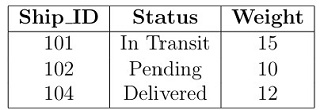
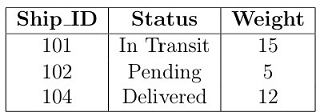
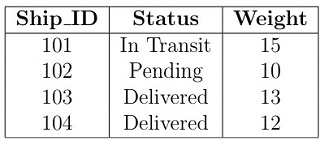
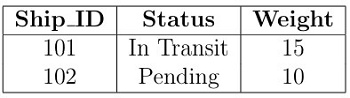
Consider the following SQL statements are executed in sequence on a newly created table Shipment:

Consider the following SQL statements are executed in sequence on a newly created table Shipment:
  1. A
    Figure from the original question paper
  2. B
    Figure from the original question paper
  3. C
    Figure from the original question paper
  4. D
    Figure from the original question paper
Show answer

Correct answer

  • A
    Figure from the original question paper

Question 4

+4 marksOne correct option

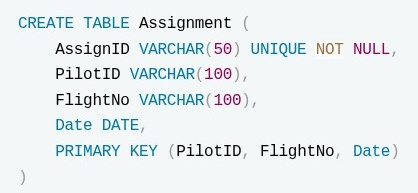
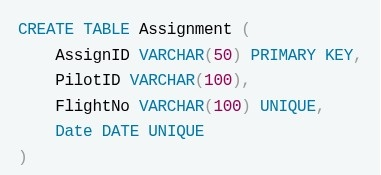
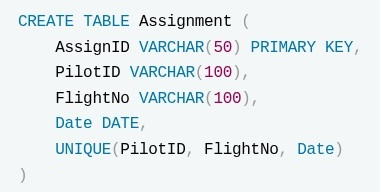
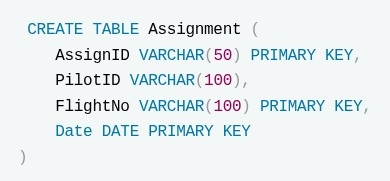
Create a table Assignment(AssignID, PilotID, FlightNo, Date) with the following criteria that must be satisfied: • Every assignment must have a unique AssignID. • Each pilot can only be assigned to a specific flight once on any given date. • Pilots may share the same flight number on different dates. Which of the following SQL queries can be used to correctly create the table Assignment?

  1. A
    Figure from the original question paper
  2. B
    Figure from the original question paper
  3. C
    Figure from the original question paper
  4. D
    Figure from the original question paper
Show answer

Correct answer

  • C
    Figure from the original question paper

Question 5

+4 marksOne correct option
Figure from the original question paper
  1. A

    Names of pilots who earn less than the most experienced person in their airline.

  2. B

    Names of pilots who earn more than the most experienced person in their airline.

  3. C

    Names of pilots who earn more than all less experienced colleagues in their airline.

  4. D

    Names of pilots who earn less than all less experienced colleagues in their airline.

Show answer

Correct answer

  • C

    Names of pilots who earn more than all less experienced colleagues in their airline.

Question 6

+4 marksOne correct option

Consider the relational schemas Pilot, Aircraft_Type and Certified:

Consider the relational schemas Pilot, Aircraft_Type and Certified:
  1. A

    Names of pilots who are certified for at least one aircraft type

  2. B

    Names of pilots who are certified for exactly one aircraft type

  3. C

    Names of pilots who are certified for all available aircraft types

  4. D

    Names of pilots who are not certified for any aircraft type

Show answer

Correct answer

  • C

    Names of pilots who are certified for all available aircraft types

Question 7

+4 marksOne or more correct options

Consider the following relational schema for a movie database:

Consider the following relational schema for a movie database:

Select all that apply.

  1. A

    —

  2. B
    Figure from the original question paper
  3. C
    Figure from the original question paper
  4. D
    Figure from the original question paper
Show answer

Correct answers

  • A

    —

  • B
    Figure from the original question paper
  • C
    Figure from the original question paper

Question 8

+4 marksOne or more correct options

Consider two relations R(A, B) and S(B, C). Which of the following SQL queries is/are logically equivalent to the Relational Algebra expression ?

Select all that apply.

  1. A
    Figure from the original question paper
  2. B
    Figure from the original question paper
  3. C
    Figure from the original question paper
  4. D
    Figure from the original question paper
Show answer

Correct answers

  • A
    Figure from the original question paper
  • B
    Figure from the original question paper
  • C
    Figure from the original question paper

Question 9

+4 marksOne or more correct options

Consider the Entity-Relationship (ER) diagram below representing an organization’s logical schema of their database:

Consider the Entity-Relationship (ER) diagram below representing an organization’s logical schema of their database:

Select all that apply.

  1. A

    The Skill attribute is multi-valued and requires a separate relational table with (Emp_ID, Skill) as its composite primary key

  2. B

    The minimum number of relational tables required to map this entire ER diagram to a relational schema is 6

  3. C

    The composite attribute Name will typically require a separate table to be mapped correctly.

  4. D

    The relational table for the weak entity Dependent will have a primary key consisting of only Dep_Name and DOB

Show answer

Correct answers

  • A

    The Skill attribute is multi-valued and requires a separate relational table with (Emp_ID, Skill) as its composite primary key

  • B

    The minimum number of relational tables required to map this entire ER diagram to a relational schema is 6

Question 10

+4 marksOne or more correct options

Consider the following two relations and

Consider the following two relations  and

Select all that apply.

  1. A

    —

  2. B

    —

  3. C

    —

  4. D

    —

Show answer

Correct answers

  • B

    —

  • D

    —

Question 11

+2 marksWritten answer

Suppose relation R(A,B,C,D) has candidate keys: {A,B} and {A,C}. How many distinct superkeys does relation R have?

Show answer

A written answer, not marked automatically.

Question 12

+2 marksOne correct option

Let R(A,B) = {(1,2),(2,3),(3,4)} and S(B,C) = {(2,5),(3,6)}. Find the number of tuples in .

  1. A

    2

  2. B

    3

  3. C

    4

  4. D

    6

Show answer

Correct answer

  • C

    4

Question 13

+2 marksOne correct option

Consider the following three tables:

Consider the following three tables:
  1. A

    2

  2. B

    3

  3. C

    4

  4. D

    5

Show answer

Correct answer

  • A

    2

Question 14

+2 marksOne correct option

Consider an EER model in which Person is a supertype entity type. Two subtype entity types, Employee and AccountHolder, are defined as specializations of Person. • A person may be an Employee only. • A person may be an AccountHolder only. • A person may be both an Employee and an AccountHolder. • A person may belong to neither subtype and exist only as a Person. Which specialization constraints apply to this specialization? Identify the constraints on specialization with respect to the above scenario.

  1. A

    Disjoint and Partial

  2. B

    Overlapping and Partial

  3. C

    Disjoint and Total

  4. D

    Overlapping and Total

Show answer

Correct answer

  • B

    Overlapping and Partial

Question 15

+3 marksOne or more correct options

Consider two relations R(A,B) and S(B). Relation R contains 10 tuples and relation S contains 2 tuples. Both relations contain strictly non-null values. Which of the following statements regarding the relational algebra division operation R÷S are TRUE?

Select all that apply.

  1. A

    The maximum possible number of tuples in R÷S is 5

  2. B

    The minimum possible number of tuples in R÷S is 1

  3. C

    R÷S can be equivalently expressed as

  4. D

    If a new, distinct tuple is inserted into relation S, the number of tuples in the resulting R ÷ S might increase

Show answer

Correct answers

  • A

    The maximum possible number of tuples in R÷S is 5

  • C

    R÷S can be equivalently expressed as

Question 16

+3 marksWritten answer

Consider the following Employee table:

Consider the following Employee table:
Show answer

A written answer, not marked automatically.