Quiz Space

May 2023 term · Computational Thinking · BSCS1001

Computational Thinking Quiz 1: 16 July 2023, Set 3 (May 2023 term)

The IIT Madras BS Computational Thinking (Computational Thinking (CT)) Quiz 1 paper sat on 16 Jul 2023, in the May 2023 term, set 3: 17 questions for 53 marks in 120 minutes. Every question is below with its answer. Take it as a timed mock test to be marked, or read it through first.

Questions
17
Marks
53
Duration
120 min
MCQ
10
MSQ
4
Written
3

Updated

Official paper: IIT M FOUNDATION AN4 EXAM QPF4 16 JULY 2023 · No negative marking.

Question 1

+1 markOne correct option

THIS IS QUESTION PAPER FOR THE SUBJECT "FOUNDATION LEVEL : SEMESTER 1: COMPUTATIONAL THINKING (COMPUTER BASED EXAM)" ARE YOU SURE YOU HAVE TO WRITE EXAM FOR THIS SUBJECT? CROSS CHECK YOUR HALL TICKET TO CONFIRM THE SUBJECTS TO BE WRITTEN. (IF IT IS NOT THE CORRECT SUBJECT, PLS CHECK THE SECTION AT THE TOP FOR THE SUBJECTS REGISTERED BY YOU)

  1. A

    YES

  2. B

    NO

Show answer

Correct answer

  • A

    YES

Question 2

+1 markOne correct option
Figure from the original question paper
  1. A

    Useful Data has been mentioned above.

  2. B

    This data attachment is just for a reference & not for an evaluation.

Show answer

Correct answer

  • A

    Useful Data has been mentioned above.

Question 3

+3 marksOne correct option

The following pseudocode is executed using the "Words" dataset. What will count represent at the end of the execution?

The following pseudocode is executed using the "Words" dataset. What will count represent at the end of the execution?

The following pseudocode is executed using the "Words" dataset. What will count represent at the end of the execution?
  1. A

    Number of words which are adjectives and have at least two letters

  2. B

    Number of words which are either adjectives or have at most two letters butnot both

  3. C

    Number of words which are adjectives or have at most two letters or both

  4. D

    Number of words which are not adjectives and have exactly two letters

Show answer

Correct answer

  • C

    Number of words which are adjectives or have at most two letters or both

Question 4

+3 marksOne correct option

The following pseudocode is executed using the “Library” dataset. What will A represent at the end of execution?

The following pseudocode is executed using the “Library” dataset. What will A represent at the end of execution?

The following pseudocode is executed using the “Library” dataset. What will A represent at the end of execution?
  1. A

    Number of books written by author Kalam in English

  2. B

    Number of books not written by author Kalam in English

  3. C

    Number of English books written by authors other than Kalam

  4. D

    Number of books that are written by Kalam or in English or both

Show answer

Correct answer

  • D

    Number of books that are written by Kalam or in English or both

Question 5

+3 marksOne correct option

The given pseudocode is executed using the “Words” dataset. Assume that vCount(X) returns the number of vowels in X.Word. What will B represent at the end of the execution?

The given pseudocode is executed using the “Words” dataset. Assume that vCount(X) returns the number of vowels in X.Word. What will B represent at the end of the execution?

The given pseudocode is executed using the “Words” dataset. Assume that vCount(X) returns the number of vowels in X.Word
  1. A

    Average letter count of words in the dataset

  2. B

    Sum of words that contain at least two vowels

  3. C

    Average letter count of words containing at least two vowels in the dataset

  4. D

    Average letter count of words containing at most two vowels in the dataset

Show answer

Correct answer

  • C

    Average letter count of words containing at least two vowels in the dataset

Question 6

+3 marksOne correct option

Consider the "Scores" dataset. What will C represent at the end of the execution?

Consider the "Scores" dataset. What will C represent at the end of the execution?

Consider the "Scores" dataset. What will C represent at the end of the execution?
  1. A

    Sum of Total marks of students whose Physics marks are less than the averagePhysics marks

  2. B

    Sum of Total marks of students whose Physics marks are more than theaverage Physics marks

  3. C

    Sum of Physics marks of students whose Physics marks are more than theaverage Physics marks

  4. D

    Sum of Physics marks of students whose Physics marks are less than theaverage Physics marks

Show answer

Correct answer

  • B

    Sum of Total marks of students whose Physics marks are more than theaverage Physics marks

Question 7

+3 marksOne correct option

The following pseudocode is executed using the “Words” dataset. What will A represent at the end of the execution?

The following pseudocode is executed using the “Words” dataset. What will A represent at the end of the execution?

The following pseudocode is executed using the “Words” dataset. What will A represent at the end of the execution?
  1. A

    Number of words with at most two vowels

  2. B

    Number of words with at least three vowels

  3. C

    Number of words with at least two vowels

  4. D

    Number of words with exactly two vowels

Show answer

Correct answer

  • B

    Number of words with at least three vowels

Question 8

+4 marksOne correct option

Consider the Player dataset given below that keeps track of the runs scored by each player in the test matches held.

Consider the Player dataset given below that keeps track of the runs scored by each player in the test matches held.

Consider the Player dataset given below that keeps track of the runs scored by each player in the test matches held.

Consider the Player dataset given below that keeps track of the runs scored by each player in the test matches held.
  1. A

    GoldStriker

  2. B

    SilverStriker

  3. C

    BronzeStriker

  4. D

    SilverStriker and BronzeStriker

Show answer

Correct answer

  • A

    GoldStriker

Question 9

+4 marksOne or more correct options

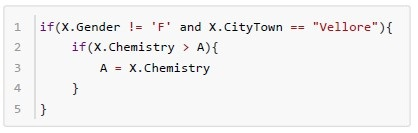
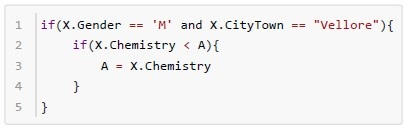
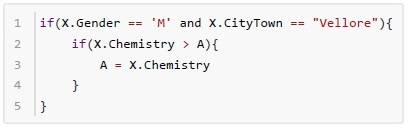
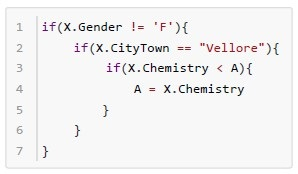
The following pseudocode is executed using the “Scores” dataset. At the end of the execution, A captures the lowest Chemistry marks scored by a male student from Vellore. Choose the correct code fragment(s) to complete the pseudocode. It is a Multiple Select Question.

The following pseudocode is executed using the “Scores” dataset. At the end of the execution, A captures the lowest Chemistry marks scored by a male student from Vellore. Choose the correct code fragment(s) to complete the pseudocode. It is a Multiple Select Question.

The following pseudocode is executed using the “Scores” dataset. At the end of the execution, A captures the lowest Chem

Select all that apply.

  1. A
    Figure from the original question paper
  2. B
    Figure from the original question paper
  3. C
    Figure from the original question paper
  4. D
    Figure from the original question paper
Show answer

Correct answers

  • B
    Figure from the original question paper
  • D
    Figure from the original question paper

Question 10

+4 marksOne or more correct options

The following pseudocode is executed using the “Olympics” dataset. At the end of the execution, A stores the number of players who are either female from India or have won the match hosted by Australia in the year 2006 or both. But the pseudocode may have mistakes. Identify all such mistakes (if any). Assume that all statements not listed in the options below are free of errors. It is a Multiple Select Question .

The following pseudocode is executed using the “Olympics” dataset. At the end of the execution, A stores the number of players who are either female from India or have won the match hosted by Australia in the year 2006 or both. But the pseudocode may have mistakes. Identify all such mistakes (if any). Assume that all statements not listed in the options below are free of errors. It is a Multiple Select Question .

The following pseudocode is executed using the “Olympics” dataset. At the end of the execution, A stores the number of p

Select all that apply.

  1. A

    Line 1: Incorrect initialization of A

  2. B

    Line 5: Condition to update C is incorrect

  3. C

    Line 8: Condition to update D is incorrect

  4. D

    No error in the code

Show answer

Correct answers

  • B

    Line 5: Condition to update C is incorrect

  • C

    Line 8: Condition to update D is incorrect

Question 11

+5 marksOne or more correct options
Figure from the original question paper

Select all that apply.

  1. A
    Figure from the original question paper
  2. B
    Figure from the original question paper
  3. C
    Figure from the original question paper
  4. D
    Figure from the original question paper
Show answer

Correct answers

  • A
    Figure from the original question paper
  • D
    Figure from the original question paper

Question 12

+4 marksWritten answer
Figure from the original question paper
Show answer

A written answer, not marked automatically.

Question 13

+3 marksWritten answer

Let the value of X be "aeroplane". What is the value of A at the end of the execution of the pseudocode ?

Let the value of X be "aeroplane". What is the value of A at the end of the execution of the pseudocode ?

Let the value of X be "aeroplane". What is the value of A at the end of the execution of the pseudocode ?
Show answer

A written answer, not marked automatically.

Question 14

+3 marksOne correct option

Based on the above data, answer the given subquestions.

Based on the above data, answer the given subquestions.

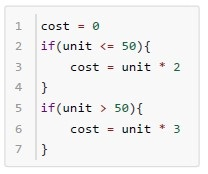
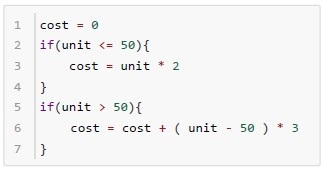
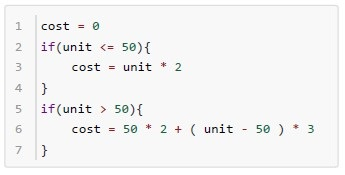
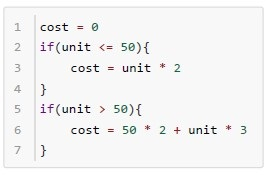
Let unit be the number of units consumed by the consumer and cost be the amount of the bill to be paid. Choose the correct implementation to compute the cost.

  1. A
    Figure from the original question paper
  2. B
    Figure from the original question paper
  3. C
    Figure from the original question paper
  4. D
    Figure from the original question paper
Show answer

Correct answer

  • C
    Figure from the original question paper

Question 15

+3 marksOne correct option

Based on the above data, answer the given subquestions.

Based on the above data, answer the given subquestions.
Figure from the original question paper
  1. A
    Figure from the original question paper
  2. B
    Figure from the original question paper
  3. C
    Figure from the original question paper
  4. D
    Figure from the original question paper
Show answer

Correct answer

  • D
    Figure from the original question paper

Question 16

+5 marksOne or more correct options

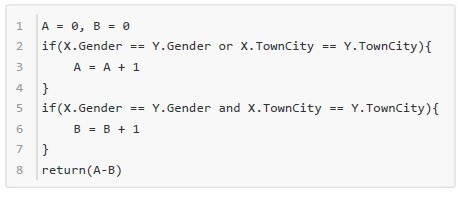
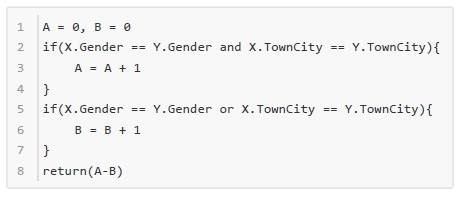
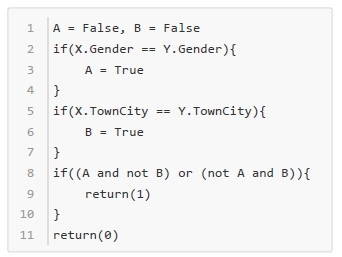
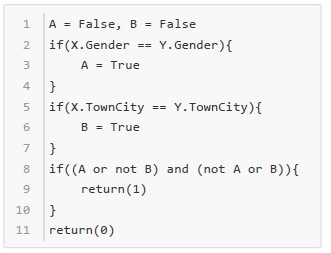
The following pseudocode is executed using the "Scores" dataset. At the end of the execution, count captures the number of pairs of students who are of the same gender or are from the same city but not both. Choose the correct code fragment to complete the pseudocode. It is a Multiple Select Question.

The following pseudocode is executed using the "Scores" dataset. At the end of the execution, count captures the number of pairs of students who are of the same gender or are from the same city but not both. Choose the correct code fragment to complete the pseudocode. It is a Multiple Select Question.

The following pseudocode is executed using the "Scores" dataset. At the end of the execution, count captures the number

Select all that apply.

  1. A
    Figure from the original question paper
  2. B
    Figure from the original question paper
  3. C
    Figure from the original question paper
  4. D
    Figure from the original question paper
Show answer

Correct answers

  • A
    Figure from the original question paper
  • C
    Figure from the original question paper

Question 17

+1 markWritten answer

Based on the above data, answer the given subquestions.

Based on the above data, answer the given subquestions.
Show answer

A written answer, not marked automatically.