
Question 1
Useful Data has been mentioned above.
This data attachment is just for a reference & not for an evaluation.

The IIT Madras BS Statistics for Data Science II (Stats 2) Quiz 1 paper sat on 15 Mar 2026, in the January 2026 term: 26 questions for 47 marks in 120 minutes. Every question is below with its answer. Take it as a timed mock test to be marked, or read it through first.
Useful Data has been mentioned above.
This data attachment is just for a reference & not for an evaluation.
Correct answer
Useful Data has been mentioned above.
The number of people who make a reservation in a restaurant on a particular day is a random variable with mean equal to 10 and variance equal to 5. Find a lower bound on the probability that on a particular day, number of reservations made will lie in between 5 and 15 using Chebyshev's inequality. Enter the answer correct to two decimal places.
A written answer, not marked automatically.
Let and be three random variables with Cov , Cov , Cov , Var Define the new random variables and . Find the value of Cov .
A written answer, not marked automatically.
At a bank, the time (in minutes) that a customer waits to be served is a continuous random variable with probability density function
Find the value of .
A written answer, not marked automatically.
A delivery company operates two independent service counters A and B. Let and denote the number of parcels processed by counters A and B in one hour, respectively. The joint probability mass function of and is given as:
To assess workload, the management defines the hourly load index as the maximum number of parcels processed by counters A and B in a given hour. Find the probability that the hourly load index is equal to the number of parcels processed by counter A.
Enter the correct option number for .
A written answer, not marked automatically.
A delivery company operates two independent service counters A and B. Let and denote the number of parcels processed by counters A and B in one hour, respectively. The joint probability mass function of and is given as:
To assess workload, the management defines the hourly load index as the maximum number of parcels processed by counters A and B in a given hour. Find the probability that the hourly load index is equal to the number of parcels processed by counter A.
Enter the correct option number for .
A written answer, not marked automatically.
A delivery company operates two independent service counters A and B. Let and denote the number of parcels processed by counters A and B in one hour, respectively. The joint probability mass function of and is given as:
To assess workload, the management defines the hourly load index as the maximum number of parcels processed by counters A and B in a given hour. Find the probability that the hourly load index is equal to the number of parcels processed by counter A.
Enter the correct option number for .
A written answer, not marked automatically.
A delivery company operates two independent service counters A and B. Let and denote the number of parcels processed by counters A and B in one hour, respectively. The joint probability mass function of and is given as:
To assess workload, the management defines the hourly load index as the maximum number of parcels processed by counters A and B in a given hour. Find the probability that the hourly load index is equal to the number of parcels processed by counter A.
Enter the correct option number for .
A written answer, not marked automatically.
A delivery company operates two independent service counters A and B. Let and denote the number of parcels processed by counters A and B in one hour, respectively. The joint probability mass function of and is given as:
To assess workload, the management defines the hourly load index as the maximum number of parcels processed by counters A and B in a given hour. Find the probability that the hourly load index is equal to the number of parcels processed by counter A.
Calculate the value for . Enter the answer correct to one decimal place.
A written answer, not marked automatically.
A box contains one red ball and one blue ball. Two balls are drawn one after another with replacement and the colour of each ball drawn is recorded. Let • A be the number of times a red ball is drawn in the two draws. • B be the number of times a blue ball is drawn in the two draws. Choose the correct statement(s) from the following.
The possible values of are {0, 1, 2}
The possible values of are {1, 2}
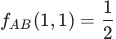
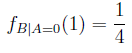
Correct answers
The possible values of are {0, 1, 2}
The number of vehicles ( ) passing a signal in a day follows a Poisson distribution with parameter . Each vehicle independently violates traffic rules with probability 0.1. Let denote the number of vehicles violating traffic rules in a day. Based on the above data, answer the given subquestions.
Which of the following option(s) is/are true?
Binomial(15, 0.1)
Binomial(30, 0.1)
Poisson(0.1)
—
Correct answers
Binomial(15, 0.1)
—
The number of vehicles ( ) passing a signal in a day follows a Poisson distribution with parameter . Each vehicle independently violates traffic rules with probability 0.1. Let denote the number of vehicles violating traffic rules in a day. Based on the above data, answer the given subquestions.
Find the value of Var(2X)−3Var(Y ) + 4.
A written answer, not marked automatically.
A small bookstore tracks the number of books sold in an hour. Let a discrete random variable denote the number of books sold in an hour. The probability mass function of is given by:
The store defines a discount indicator as:
Based on the above data, answer the given subquestions.
Find the value of . Enter the answer correct to two decimal places.
A written answer, not marked automatically.
A small bookstore tracks the number of books sold in an hour. Let a discrete random variable denote the number of books sold in an hour. The probability mass function of is given by:
The store defines a discount indicator as:
Based on the above data, answer the given subquestions.
Find the value of . Enter the answer correct to two decimal places.
A written answer, not marked automatically.
A fair coin is tossed three times. Let denote the number of heads in the first toss and be the total number of heads obtained across all three tosses. Based on this, answer the given sub questions:
Find the value of .


Correct answer
A fair coin is tossed three times. Let denote the number of heads in the first toss and be the total number of heads obtained across all three tosses. Based on this, answer the given sub questions:
Find the value of . Enter the answer correct to three decimal places.
A written answer, not marked automatically.
The joint PMF of two discrete random variables and is given as:
Based on the above data, answer the given subquestions.
Find the value of .
A written answer, not marked automatically.
The joint PMF of two discrete random variables and is given as:
Based on the above data, answer the given subquestions.
Find the value of .


Correct answer
The amount of rainfall (in cm) on a randomly chosen rainy day in a city is a continuous random variable with cumulative distribution function
Based on the above data, answer the given subquestions.
Which of the following options correctly represents the probability density function of ?
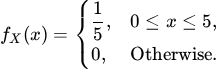
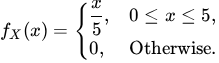
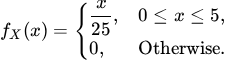
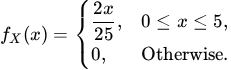
Correct answer
The amount of rainfall (in cm) on a randomly chosen rainy day in a city is a continuous random variable with cumulative distribution function
Based on the above data, answer the given subquestions.
Find the value of .


Correct answer
A delivery company operates two independent service counters A and B. Let and denote the number of parcels processed by counters A and B in one hour, respectively. The joint probability mass function of and is given as:
To assess workload, the management defines the hourly load index as the maximum number of parcels processed by counters A and B in a given hour. Find the probability that the hourly load index is equal to the number of parcels processed by counter A.
A written answer, not marked automatically.
The number of vehicles ( ) passing a signal in a day follows a Poisson distribution with parameter . Each vehicle independently violates traffic rules with probability 0.1. Let denote the number of vehicles violating traffic rules in a day. Based on the above data, answer the given subquestions.
A written answer, not marked automatically.
A small bookstore tracks the number of books sold in an hour. Let a discrete random variable denote the number of books sold in an hour. The probability mass function of is given by:
The store defines a discount indicator as:
Based on the above data, answer the given subquestions.
A written answer, not marked automatically.
A fair coin is tossed three times. Let denote the number of heads in the first toss and be the total number of heads obtained across all three tosses. Based on this, answer the given sub questions:
A written answer, not marked automatically.
The joint PMF of two discrete random variables and is given as:
Based on the above data, answer the given subquestions.
A written answer, not marked automatically.
The amount of rainfall (in cm) on a randomly chosen rainy day in a city is a continuous random variable with cumulative distribution function
Based on the above data, answer the given subquestions.
A written answer, not marked automatically.