uiz Space

January 2026 term · Reinforcement Learning · BSDA5007

Reinforcement Learning Quiz 1: 15 March 2026 (January 2026 term)

The IIT Madras BS Reinforcement Learning (Reinforcement Learning) Quiz 1 paper sat on 15 Mar 2026, in the January 2026 term: 22 questions for 34 marks in 120 minutes. Every question is below with its answer. Take it as a timed mock test to be marked, or read it through first.

Questions
22
Marks
34
Duration
120 min
MCQ
11
MSQ
1
Written
10

Updated

Official paper: Reinforcement Learning 15 Mar 26 · No negative marking.

Question 1

+2 marksOne correct option

Which of the following is/are correct and valid reasons to consider sampling actions from a softmax distribution instead of using an greedy approach? 1.Under softmax exploration, the probability of selecting an action increases with its estimated action value, which reduces unnecessary exploration of clearly inferior actions. 2.Unlike the -greedy method, softmax exploration does not require careful, gradual decay of the exploration parameter and still yields asymptotically correct behaviour even if the temperature is reduced sharply. 3.It enables more fine-grained discrimination among actions whose estimated Q-values are close to the maximum, allowing more nuanced preference for slightly better actions. Which of the above statements is/are correct?

  1. A

    1, 2, 3

  2. B

    only 3

  3. C

    1, 2

  4. D

    1, 3

  5. E

    3, 2

  6. F

    Only 2

Show answer

Correct answer

  • D

    1, 3

Question 2

+2 marksOne correct option

Consider a discounted return:

in an infinite-horizon MDP with bounded rewards and discount factor 1.For fixed rewards, the contribution of to decays geometrically as . 2.If and rewards are uniformly bounded, the infinite sum is always finite. 3.For , the discounted return is bounded above in magnitude by

. Here, Rmax be the maximum reward for any transition. Which of the above statements is/are correct?

Consider a discounted return:
  1. A

    1, 2, 3

  2. B

    1, 3

  3. C

    2, 3

  4. D

    only 1

  5. E

    only 3

Show answer

Correct answer

  • B

    1, 3

Question 3

+1 markOne correct option

Consider the following assertion and reason pair and select the correct option: Assertion:In the UCB algorithm for multi-armed bandits, replacing the upper confidence bound with a lower confidence bound (and greedily selecting actions based on that lower bound) would still promote effective exploration or lead to optimal reward maximisation. Reason:Even when lower confidence bounds are used instead of upper bounds, if the algorithm greedily selects arms based on these lower bounds, it would still encourage exploration and ultimately achieve optimal reward maximisation.

  1. A

    Both Assertion and Reason are true, and Reason is the correct explanation of Assertion.

  2. B

    Both Assertion and Reason are true, but Reason is NOT the correct explanation of Assertion.

  3. C

    Assertion is true, Reason is false

  4. D

    Assertion is false, Reason is false

Show answer

Correct answer

  • D

    Assertion is false, Reason is false

Question 4

+1 markOne correct option

In the context of MDPs, what does it mean for a policy to be greedy with respect to an action- value function ?

  1. A

    For each state , selects actions that minimise

  2. B

    For each state , selects actions that maximise

  3. C

    For each state , ignores and follows a fixed, pre-defined schedule.

  4. D

    For each state , selects actions uniformly at random regardless of

Show answer

Correct answer

  • B

    For each state , selects actions that maximise

Question 5

+2 marksOne correct option

In policy iteration for finite MDPs, how are the Bellman equations used during the policy evaluation step?

  1. A

    They are ignored; policy iteration does not rely on Bellman equations.

  2. B

    They are used to compute exactly (or approximately) for the current policy

  3. C

    They are used to directly compute the optimal policy without evaluating intermediate policies.

  4. D

    They are used to compute immediate rewards without considering transitions.

Show answer

Correct answer

  • B

    They are used to compute exactly (or approximately) for the current policy

Question 6

+2 marksOne correct option

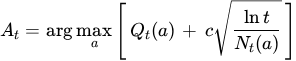
In a -armed bandit setting, we maintain a running estimate of the action-value for each arm , denoted . We now consider using an upper confidence bound (UCB) style rule for arm selection at time , where is the number of times arm has been selected up to time , and is a tunable hyperparameter. Which of the following are good strategies for arm selection?

  1. A
    Figure from the original question paper
  2. B
    Figure from the original question paper
  3. C
    Figure from the original question paper
  4. D
    Figure from the original question paper
  5. E

    None of these

Show answer

Correct answer

  • A
    Figure from the original question paper

Question 7

+2 marksOne or more correct options

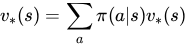
Which of the following equations best represents the Bellman optimality equation for the optimal state-value function

Select all that apply.

  1. A
    Figure from the original question paper
  2. B
    Figure from the original question paper
  3. C
    Figure from the original question paper
  4. D

    —

Show answer

Correct answers

  • A
    Figure from the original question paper
  • C
    Figure from the original question paper

Question 8

+2 marksWritten answer

The sequence of rewards for a continuing task with is given below:

Find the return . Your answer should have exactly two places after the decimal point.

The sequence of rewards for a continuing task with  is given below:
Show answer

A written answer, not marked automatically.

Question 9

+2 marksWritten answer

You have a 3-armed bandit where each arm, when active, yields a Bernoulli reward with success probabilities , , and . However, arm 1 is active in any given round with probability , and otherwise it yields a reward of 0 regardless of its Bernoulli outcome. Arms 2 and 3 are always active. What is the expected reward from pulling arm 1 in a single round?

Show answer

A written answer, not marked automatically.

Question 10

+1 markWritten answer

Consider a Markov Decision Process (MDP) with three states , , and , where is a terminal state and . Each non-terminal state has a single available action, and the transitions are deterministic with associated rewards: the agent moves from to and receives a reward of 1, and from to and receives a reward of 2. Let the discount factor be . Based on the above data, answer the given subquestions.

Assume the initial value estimates are , , and . After performing one synchronous policy evaluation update (under the fixed policy that follows the chain), determine and . Compute the ratio

Assume the initial value estimates are  ,  , and  . After performing one synchronous policy evaluation update (under the
Show answer

A written answer, not marked automatically.

Question 11

+1 markWritten answer

Consider a Markov Decision Process (MDP) with three states , , and , where is a terminal state and . Each non-terminal state has a single available action, and the transitions are deterministic with associated rewards: the agent moves from to and receives a reward of 1, and from to and receives a reward of 2. Let the discount factor be . Based on the above data, answer the given subquestions.

Starting from , , and . perform two successive synchronous policy evaluation sweeps (under the fixed policy that follows the chain). What is after these two sweeps?

Show answer

A written answer, not marked automatically.

Question 12

+1 markWritten answer

Consider a 2-state MDP with states and , discount factor . There are two actions in : and . Action gives immediate reward and moves deterministically to ; action gives immediate reward and keeps the agent in . In , there is a single action that yields an immediate reward and transitions back to . Assume initial value estimates are , Based on the above data, answer the given subquestions.

If you perform a single value iteration Bellman optimality update for , what is the new value ?

Show answer

A written answer, not marked automatically.

Question 13

+1 markWritten answer

Consider a 2-state MDP with states and , discount factor . There are two actions in : and . Action gives immediate reward and moves deterministically to ; action gives immediate reward and keeps the agent in . In , there is a single action that yields an immediate reward and transitions back to . Assume initial value estimates are , Based on the above data, answer the given subquestions.

Suppose after some value iterations your current estimates are , . If you perform one value iteration update for , what is the new value ?

Show answer

A written answer, not marked automatically.

Question 14

+2 marksOne correct option

Consider an N-armed bandit problem in which each arm , for , produces a reward of 1 with probability and otherwise, where denotes the arm’s base success probability. Assume the bandit machine suffers from a hardware malfunction: when the agent attempts to pull arm , the intended action is not always executed. Instead, with probability a wiring fault causes the machine to randomly activate one arm chosen uniformly from the set , regardless of the agent’s selection, and the reward is generated according to that arm’s reward distribution. We refer to this malfunction as -noise activation Based on the above data, answer the given subquestions.

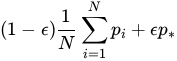
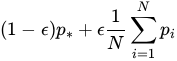
Consider a faulty -armed bandit with -noise activation and base arm success probabilities . If you always choose the arm with the highest base success probability , what is the expected payoff per pull under this greedy strategy?

  1. A
    Figure from the original question paper
  2. B

    —

  3. C
    Figure from the original question paper
  4. D
    Figure from the original question paper
Show answer

Correct answer

  • D
    Figure from the original question paper

Question 15

+2 marksOne correct option

Consider an N-armed bandit problem in which each arm , for , produces a reward of 1 with probability and otherwise, where denotes the arm’s base success probability. Assume the bandit machine suffers from a hardware malfunction: when the agent attempts to pull arm , the intended action is not always executed. Instead, with probability a wiring fault causes the machine to randomly activate one arm chosen uniformly from the set , regardless of the agent’s selection, and the reward is generated according to that arm’s reward distribution. We refer to this malfunction as -noise activation Based on the above data, answer the given subquestions.

Consider a faulty -armed bandit with -noise activation and distinct base success probabilities . Suppose the agent follows a greedy strategy that always chooses the arm with the highest empirical mean reward. How does the presence of activation noise affect the asymptotic fraction of time for which the optimal arm (with success probability ) is actually executed?

  1. A

    Noise has no effect; the optimal arm is activated almost surely in the long run.

  2. B

    Noise reduces the frequency with which the optimal arm is selected, but once it is selected, it is always activated.

  3. C

    Noise eventually causes the greedy policy to oscillate indefinitely between arms, preventing convergence.

  4. D

    Even when the greedy policy converges to always selecting the optimal arm, activation noise prevents the optimal arm from being activated more than a fraction of the time.

Show answer

Correct answer

  • D

    Even when the greedy policy converges to always selecting the optimal arm, activation noise prevents the optimal arm from being activated more than a fraction of the time.

Question 16

+2 marksOne correct option

Consider an N-armed bandit problem in which each arm , for , produces a reward of 1 with probability and otherwise, where denotes the arm’s base success probability. Assume the bandit machine suffers from a hardware malfunction: when the agent attempts to pull arm , the intended action is not always executed. Instead, with probability a wiring fault causes the machine to randomly activate one arm chosen uniformly from the set , regardless of the agent’s selection, and the reward is generated according to that arm’s reward distribution. We refer to this malfunction as -noise activation Based on the above data, answer the given subquestions.

In a faulty -armed bandit with -noise activation, suppose you mistakenly model the environment as a standard bandit without activation noise. You estimate each arm’s success probability using sample averages of observed rewards. How does the -noise affect your estimates of the true base success probabilities ?

  1. A

    Your estimates are biased toward the overall average success probability across all arms.

  2. B

    Your estimates are biased upward, overestimating all

  3. C

    Your estimates remain unbiased for because you still observe correct rewards for the arm you believe you pulled.

  4. D

    Your estimates are biased downward, underestimating all

Show answer

Correct answer

  • A

    Your estimates are biased toward the overall average success probability across all arms.

Question 17

+2 marksOne correct option

Consider a large-scale news recommendation platform that uses a contextual bandit approach to decide which headline to show to a user visiting the homepage. The context includes user features (e.g., location, device type, time of day, coarse interest profile) and article features (e.g., topic, recency, source reputation). Actions correspond to recommending one of the candidate headlines, and the reward is if the user clicks the recommended headline and otherwise. Let the context vector at time encode both user and article features for the current recommendation opportunity. There are discrete actions, each corresponding to selecting one of the candidate headlines for display. Based on the above data, answer the given subquestions.

Which of the following best explains why a contextual bandit approach is preferred over a standard multi-armed bandit in this news recommendation scenario?

  1. A

    Because user preferences are identical for all users, so context does not influence click behaviour.

  2. B

    Because contextual bandits can tailor recommendations to each user and article pair using the context, thereby improving click-through rates across heterogeneous users.

  3. C

    Because standard multi-armed bandits cannot perform any exploration at all.

  4. D

    Because contextual bandits guarantee that the same headline is always optimal for every user.

Show answer

Correct answer

  • B

    Because contextual bandits can tailor recommendations to each user and article pair using the context, thereby improving click-through rates across heterogeneous users.

Question 18

+2 marksOne correct option

Consider a large-scale news recommendation platform that uses a contextual bandit approach to decide which headline to show to a user visiting the homepage. The context includes user features (e.g., location, device type, time of day, coarse interest profile) and article features (e.g., topic, recency, source reputation). Actions correspond to recommending one of the candidate headlines, and the reward is if the user clicks the recommended headline and otherwise. Let the context vector at time encode both user and article features for the current recommendation opportunity. There are discrete actions, each corresponding to selecting one of the candidate headlines for display. Based on the above data, answer the given subquestions.

After many rounds of user interaction, what is the main optimality objective of the contextual bandit algorithm in this recommendation setting?

  1. A

    Maximise the cumulative expected number of clicks by acting as closely as possible to the best policy that maps contexts to headlines.

  2. B

    Ensure that on every single round, it always picks the empirically highest-CTR headline observed so far, regardless of context.

  3. C

    Minimise the variance of rewards, even if that substantially reduces the total number of clicks.

  4. D

    Focus only on the worst-performing user segment and ignore the rest.

Show answer

Correct answer

  • A

    Maximise the cumulative expected number of clicks by acting as closely as possible to the best policy that maps contexts to headlines.

Question 19

+1 markWritten answer

Consider a Markov Decision Process (MDP) with three states , , and , where is a terminal state and . Each non-terminal state has a single available action, and the transitions are deterministic with associated rewards: the agent moves from to and receives a reward of 1, and from to and receives a reward of 2. Let the discount factor be . Based on the above data, answer the given subquestions.

Show answer

A written answer, not marked automatically.

Question 20

+1 markWritten answer

Consider a 2-state MDP with states and , discount factor . There are two actions in : and . Action gives immediate reward and moves deterministically to ; action gives immediate reward and keeps the agent in . In , there is a single action that yields an immediate reward and transitions back to . Assume initial value estimates are , Based on the above data, answer the given subquestions.

Show answer

A written answer, not marked automatically.

Question 21

+1 markWritten answer

Consider an N-armed bandit problem in which each arm , for , produces a reward of 1 with probability and otherwise, where denotes the arm’s base success probability. Assume the bandit machine suffers from a hardware malfunction: when the agent attempts to pull arm , the intended action is not always executed. Instead, with probability a wiring fault causes the machine to randomly activate one arm chosen uniformly from the set , regardless of the agent’s selection, and the reward is generated according to that arm’s reward distribution. We refer to this malfunction as -noise activation Based on the above data, answer the given subquestions.

Show answer

A written answer, not marked automatically.

Question 22

+1 markWritten answer

Consider a large-scale news recommendation platform that uses a contextual bandit approach to decide which headline to show to a user visiting the homepage. The context includes user features (e.g., location, device type, time of day, coarse interest profile) and article features (e.g., topic, recency, source reputation). Actions correspond to recommending one of the candidate headlines, and the reward is if the user clicks the recommended headline and otherwise. Let the context vector at time encode both user and article features for the current recommendation opportunity. There are discrete actions, each corresponding to selecting one of the candidate headlines for display. Based on the above data, answer the given subquestions.

Show answer

A written answer, not marked automatically.