
Question 1
Only S1 is correct.
Only S2 is correct.
Only S1 and S3 are correct.
Only S1 and S2 are correct.
S1, S2, and S3 are all correct.

The IIT Madras BS Mathematics for Data Science II (Maths 2) Quiz 1 paper sat on 15 Mar 2026, in the January 2026 term: 45 questions for 156 marks in 120 minutes. Every question is below with its answer. Take it as a timed mock test to be marked, or read it through first.
Only S1 is correct.
Only S2 is correct.
Only S1 and S3 are correct.
Only S1 and S2 are correct.
S1, S2, and S3 are all correct.
Correct answer
Only S1 and S3 are correct.
Only S1 is correct.
Only S2 is correct.
Only S1 and S3 are correct.
Only S1 and S2 are correct.
S1, S2, and S3 are all correct.
Correct answer
Only S1 and S3 are correct.
Only S1 is correct.
Only S2 is correct.
Only S1 and S3 are correct.
Only S1 and S2 are correct.
S1, S2, and S3 are all correct.
Correct answer
Only S1 and S3 are correct.
Consider a subspace of . Which of the following options describes a basis of ?
.
.
—
.
Correct answer
.
Consider a subspace of . Which of the following options describes a basis of ?
.
.
—
.
Correct answer
.
Consider a subspace of . Which of the following options describes a basis of ?
.
.
—
.
Correct answer
.
Which of the following subsets are subspaces of under the usual addition and scalar multiplication?
.
.
.
.
Correct answers
.
.
Which of the following subsets are subspaces of under the usual addition and scalar multiplication?
.
.
.
.
Correct answers
.
.
Which of the following subsets are subspaces of under the usual addition and scalar multiplication?
.
.
.
.
Correct answers
.
.
Let
where are distinct real numbers. Which of the following statements are correct?
If the sum of every row of is , then is .
changes sign if rows 2 and 4 are interchanged.
if any two of the numbers are equal.
changes sign if each row is multiplied by .
Correct answers
If the sum of every row of is , then is .
changes sign if rows 2 and 4 are interchanged.
if any two of the numbers are equal.
Let
where are distinct real numbers. Which of the following statements are correct?
If the sum of every row of is , then is .
changes sign if rows 2 and 4 are interchanged.
if any two of the numbers are equal.
changes sign if each row is multiplied by .
Correct answers
If the sum of every row of is , then is .
changes sign if rows 2 and 4 are interchanged.
if any two of the numbers are equal.
Let
where are distinct real numbers. Which of the following statements are correct?
If the sum of every row of is , then is .
changes sign if rows 2 and 4 are interchanged.
if any two of the numbers are equal.
changes sign if each row is multiplied by .
Correct answers
If the sum of every row of is , then is .
changes sign if rows 2 and 4 are interchanged.
if any two of the numbers are equal.
If is a matrix and is a matrix, then choose the set of correct options.
If is the augmented matrix and is the matrix obtained from after a finite number of elementary row operations, then the system and the system have the same set of solutions.
If is the reduced row echelon form of , then the system has at least one solution.
If is the reduced row echelon form of , then is also in reduced row echelon form.
If is the reduced row echelon form of and there is no row such that the only non zero entry lies in the last column of , then the system has at least one solution.
Correct answers
If is the augmented matrix and is the matrix obtained from after a finite number of elementary row operations, then the system and the system have the same set of solutions.
If is the reduced row echelon form of , then is also in reduced row echelon form.
If is the reduced row echelon form of and there is no row such that the only non zero entry lies in the last column of , then the system has at least one solution.
If is a matrix and is a matrix, then choose the set of correct options.
If is the augmented matrix and is the matrix obtained from after a finite number of elementary row operations, then the system and the system have the same set of solutions.
If is the reduced row echelon form of , then the system has at least one solution.
If is the reduced row echelon form of , then is also in reduced row echelon form.
If is the reduced row echelon form of and there is no row such that the only non zero entry lies in the last column of , then the system has at least one solution.
Correct answers
If is the augmented matrix and is the matrix obtained from after a finite number of elementary row operations, then the system and the system have the same set of solutions.
If is the reduced row echelon form of , then is also in reduced row echelon form.
If is the reduced row echelon form of and there is no row such that the only non zero entry lies in the last column of , then the system has at least one solution.
If is a matrix and is a matrix, then choose the set of correct options.
If is the augmented matrix and is the matrix obtained from after a finite number of elementary row operations, then the system and the system have the same set of solutions.
If is the reduced row echelon form of , then the system has at least one solution.
If is the reduced row echelon form of , then is also in reduced row echelon form.
If is the reduced row echelon form of and there is no row such that the only non zero entry lies in the last column of , then the system has at least one solution.
Correct answers
If is the augmented matrix and is the matrix obtained from after a finite number of elementary row operations, then the system and the system have the same set of solutions.
If is the reduced row echelon form of , then is also in reduced row echelon form.
If is the reduced row echelon form of and there is no row such that the only non zero entry lies in the last column of , then the system has at least one solution.
A company produces two types of gadgets, A and B. • Each gadget A requires 2 hours of assembly and 3 hours of testing. • Each gadget B requires 3 hours of assembly and 2 hours of testing. The company has 8 hours of assembly and 7 hours of testing available per week. The profit from gadget A is Rs 5, and from gadget B is Rs 4. Determine the total profit if the company uses all available assembly and testing hours.
A written answer, not marked automatically.
A company produces two types of gadgets, A and B. • Each gadget A requires 2 hours of assembly and 3 hours of testing. • Each gadget B requires 3 hours of assembly and 2 hours of testing. The company has 8 hours of assembly and 7 hours of testing available per week. The profit from gadget A is Rs 5, and from gadget B is Rs 4. Determine the total profit if the company uses all available assembly and testing hours.
A written answer, not marked automatically.
A company produces two types of gadgets, A and B. • Each gadget A requires 2 hours of assembly and 3 hours of testing. • Each gadget B requires 3 hours of assembly and 2 hours of testing. The company has 8 hours of assembly and 7 hours of testing available per week. The profit from gadget A is Rs 5, and from gadget B is Rs 4. Determine the total profit if the company uses all available assembly and testing hours.
A written answer, not marked automatically.
Suppose and . Let be a vector defined as such that and . Find the value of .
A written answer, not marked automatically.
Suppose and . Let be a vector defined as such that and . Find the value of .
A written answer, not marked automatically.
Suppose and . Let be a vector defined as such that and . Find the value of .
A written answer, not marked automatically.
Suppose the vectors , and in are linearly dependent. Find the value of .
A written answer, not marked automatically.
Suppose the vectors , and in are linearly dependent. Find the value of .
A written answer, not marked automatically.
Suppose the vectors , and in are linearly dependent. Find the value of .
A written answer, not marked automatically.
Consider a shop that sells muffins, cookies, and cakes. The total sales on three consecutive days are as follows: • On Monday, 1 muffin, 2 cookies, and 3 cakes were sold for a total of 140. • On Tuesday, 2 muffins, 1 cookie, and 4 cakes were sold for a total of 160. • On Wednesday, 3 muffins, 3 cookies, and 5 cakes were sold for a total of 240. Let , , and denote the price of a muffin, a cookie, and a cake, respectively. Formulate a system of linear equations representing the above scenario and find the value of .
A written answer, not marked automatically.
Consider a shop that sells muffins, cookies, and cakes. The total sales on three consecutive days are as follows: • On Monday, 1 muffin, 2 cookies, and 3 cakes were sold for a total of 140. • On Tuesday, 2 muffins, 1 cookie, and 4 cakes were sold for a total of 160. • On Wednesday, 3 muffins, 3 cookies, and 5 cakes were sold for a total of 240. Let , , and denote the price of a muffin, a cookie, and a cake, respectively. Formulate a system of linear equations representing the above scenario and find the value of .
A written answer, not marked automatically.
Consider a shop that sells muffins, cookies, and cakes. The total sales on three consecutive days are as follows: • On Monday, 1 muffin, 2 cookies, and 3 cakes were sold for a total of 140. • On Tuesday, 2 muffins, 1 cookie, and 4 cakes were sold for a total of 160. • On Wednesday, 3 muffins, 3 cookies, and 5 cakes were sold for a total of 240. Let , , and denote the price of a muffin, a cookie, and a cake, respectively. Formulate a system of linear equations representing the above scenario and find the value of .
A written answer, not marked automatically.
Suppose the rank of the matrix
is . Based on the above data, answer the given subquestions.
Find .
A written answer, not marked automatically.
Suppose the rank of the matrix
is . Based on the above data, answer the given subquestions.
Find .
A written answer, not marked automatically.
Suppose the rank of the matrix
is . Based on the above data, answer the given subquestions.
Find .
A written answer, not marked automatically.
Suppose the rank of the matrix
is . Based on the above data, answer the given subquestions.
Find .
A written answer, not marked automatically.
Suppose the rank of the matrix
is . Based on the above data, answer the given subquestions.
Find .
A written answer, not marked automatically.
Suppose the rank of the matrix
is . Based on the above data, answer the given subquestions.
Find .
A written answer, not marked automatically.
Consider a subset of . Based on the above data, answer the given subquestions.
Which of the following options is correct?
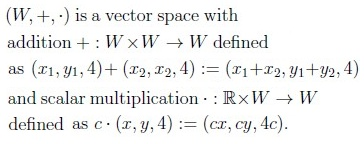
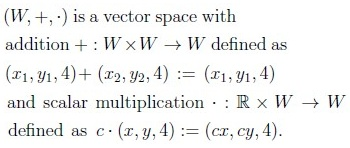
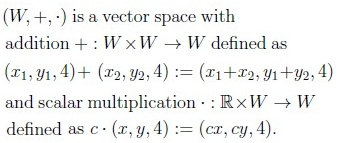
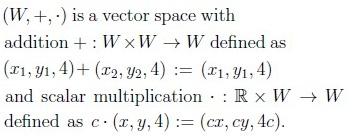
Correct answer
Consider a subset of . Based on the above data, answer the given subquestions.
Which of the following options is correct?
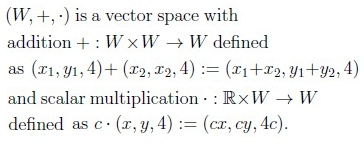
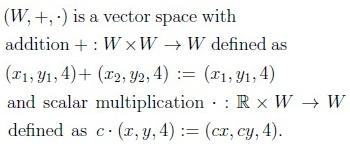
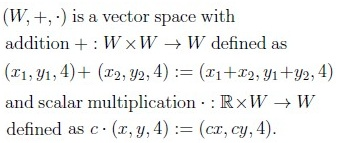
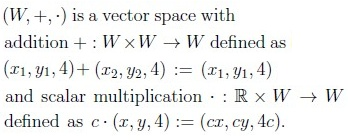
Correct answer
Consider a subset of . Based on the above data, answer the given subquestions.
Which of the following options is correct?
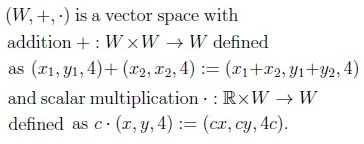
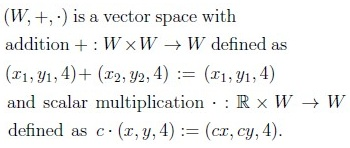
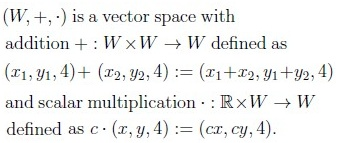
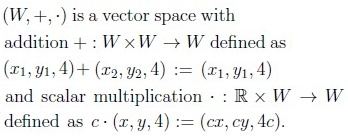
Correct answer
Consider a subset of . Based on the above data, answer the given subquestions.
Consider the vector space with the addition and scalar multiplication operations from the correct option of the previous question. What is the dimension of the vector space?
A written answer, not marked automatically.
Consider a subset of . Based on the above data, answer the given subquestions.
Consider the vector space with the addition and scalar multiplication operations from the correct option of the previous question. What is the dimension of the vector space?
A written answer, not marked automatically.
Consider a subset of . Based on the above data, answer the given subquestions.
Consider the vector space with the addition and scalar multiplication operations from the correct option of the previous question. What is the dimension of the vector space?
A written answer, not marked automatically.
Suppose the rank of the matrix
is . Based on the above data, answer the given subquestions.
A written answer, not marked automatically.
Consider a subset of . Based on the above data, answer the given subquestions.
A written answer, not marked automatically.
Suppose the rank of the matrix
is . Based on the above data, answer the given subquestions.
A written answer, not marked automatically.
Consider a subset of . Based on the above data, answer the given subquestions.
A written answer, not marked automatically.
Suppose the rank of the matrix
is . Based on the above data, answer the given subquestions.
A written answer, not marked automatically.
Consider a subset of . Based on the above data, answer the given subquestions.
A written answer, not marked automatically.