uiz Space

May 2026 term · Database Management Systems · BSCS2001

Database Management Systems Quiz 2: 16 August 2026 (May 2026 term)

The IIT Madras BS Database Management Systems (DBMS) Quiz 2 paper sat on 16 Aug 2026, in the May 2026 term: 16 questions for 50 marks in 120 minutes. Every question is below with its answer. Take it as a timed mock test to be marked, or read it through first.

Questions
16
Marks
50
Duration
120 min
MCQ
8
Written
4
MSQ
4

Updated

Official paper: Database Management Indian Institute Of Technology, Madras - Bs In Data Science/ Electronic Systems Systems 14 Aug 26 · No negative marking.

Question 1

+3 marksOne correct option

The relation Students(Name, Total_Marks) contains the names and marks of different students where no two students have the same name or total marks. What will the following SQL query return?

The relation Students(Name, Total_Marks) contains the names and marks of different students where no two students have t
  1. A

    Names of the students with the first four highest marks

  2. B

    Name of the student with the 4th highest mark

  3. C

    Names of the students with the first three highest marks

  4. D

    Name of the student with the 3rd highest mark

Show answer

Correct answer

  • C

    Names of the students with the first three highest marks

Question 2

+3 marksOne correct option

Consider a relation R(A, B, C, D, E) with following functional dependency set FD : {A → BC, CD → E, B → D, E → A} What is the highest normal form of R?

  1. A

    1NF

  2. B

    2NF

  3. C

    3NF

  4. D

    BCNF

Show answer

Correct answer

  • C

    3NF

Question 3

+3 marksOne correct option

Consider the relation R(A, B, C, D, E, F) with dependency set FD: {AB → C, E → F, AC → B, BC → A, B → D, AD → E} Following are the two decompositions of R: ●D1 : {AB, BC, EF, ABDE}●D2 : {ABC, ADF, ACDE} Choose the correct option

  1. A

    D1 is lossless decomposition but not D2

  2. B

    D2 is lossless decomposition but not D1

  3. C

    Both are lossless decomposition

  4. D

    Both are lossy decomposition

Show answer

Correct answer

  • B

    D2 is lossless decomposition but not D1

Question 4

+2 marksWritten answer

Consider a relation Student(studID, Sname, Age, Sex) where studID is the primary key. How many superkeys are possible for the relation Student?

Show answer

A written answer, not marked automatically.

Question 5

+3 marksOne or more correct options

Assume no functional dependencies other than those listed hold. Consider relation R(StudentID, StudentName, ClubID, ClubName, MentorID, MentorName, FeePaid)

Each tuple represents one student’s membership in one club. Which of the following statements are TRUE?

Assume no functional dependencies other than those listed hold. Consider relation R(StudentID, StudentName, ClubID, Club

Select all that apply.

  1. A

    In (StudentID, ClubID) → FeePaid, neither attribute is extraneous.

  2. B

    ClubID is a superkey of R.

  3. C

    MentorName is transitively dependent on a candidate key.

  4. D

    Repeating ClubName across many rows can produce an update anomaly.

  5. E

    The relation is free of redundancy because every non-key attribute appears with a key attribute.

Show answer

Correct answers

  • A

    In (StudentID, ClubID) → FeePaid, neither attribute is extraneous.

  • C

    MentorName is transitively dependent on a candidate key.

  • D

    Repeating ClubName across many rows can produce an update anomaly.

Question 6

+3 marksOne or more correct options

A DBMS stores its database on a magnetic disk. While reading a required sector, the disk arm has already moved to the correct track, but the desired sector has not yet reached the read-write head. Which of the following statements are TRUE?

Select all that apply.

  1. A

    The remaining waiting time is due to rotational latency.

  2. B

    No additional seek time is required before reading the sector.

  3. C

    The DBMS must move the disk arm to another track before the sector can be read.

  4. D

    The sector cannot be read until the entire platter completes one full rotation.

Show answer

Correct answers

  • A

    The remaining waiting time is due to rotational latency.

  • B

    No additional seek time is required before reading the sector.

Question 7

+3 marksOne or more correct options

Consider a relation R(A, B, C, D, E) with the following multivalued dependencies: ●A →→ B● B →→ D Suppose relation R contains the tuples (0, 1, 2, 3, 4) and (0, 5, 6, 7, 8). Which of the following tuple(s) must also be in R?

Select all that apply.

  1. A

    (0, 1, 2, 7, 4)

  2. B

    (0, 5, 2, 3, 4)

  3. C

    (0, 1, 6, 7, 4)

  4. D

    (0, 5, 2, 7, 4)

Show answer

Correct answers

  • A

    (0, 1, 2, 7, 4)

  • B

    (0, 5, 2, 3, 4)

  • D

    (0, 5, 2, 7, 4)

Question 8

+3 marksOne or more correct options

Which of the following are correct probe sequences in Binary Search Trees?

Select all that apply.

  1. A

    11,66,32,49,38

  2. B

    12,13,60,50,70

  3. C

    20,80,30,69,21

  4. D

    61,52,14,17,43

Show answer

Correct answers

  • A

    11,66,32,49,38

  • D

    61,52,14,17,43

Question 9

+2 marksOne correct option

Consider the relation schema R(A,B,C) with functional dependency set F = {A → B, B → C} Two database instances I1 and I2 over R both satisfy F. ●In I1, all values happen to be distinct.●In I2, many values repeat. Which statement is correct?

  1. A

    I2 can have a lower highest normal form solely because it contains repeated values.

  2. B

    The highest normal form for both the instances is 2NF.

  3. C

    I1 is automatically in BCNF because distinct values imply every determinant is a key.

  4. D

    I2 is automatically not in 2NF because repeated values exist.

Show answer

Correct answer

  • B

    The highest normal form for both the instances is 2NF.

Question 10

+2 marksOne correct option

In Python Postgres database connectivity the cursor.fetchmany() method is used to retrieve data from a table. What does this method returns?

  1. A

    A dictionary

  2. B

    A list of tuples

  3. C

    The required tuple

  4. D

    List of dictionary

Show answer

Correct answer

  • B

    A list of tuples

Question 11

+4 marksOne correct option

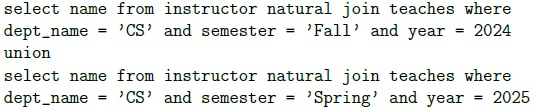
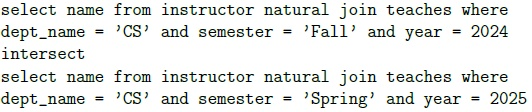
Consider the above two tables belonging to University database. Select all the SQL queries that would fetch distinct names of instructors who belong to CS department and who have taught courses in both Fall of 2024 and Spring of 2025.

Consider the above two tables belonging to University database. Select all the SQL queries that would fetch distinct nam
  1. A
    Figure from the original question paper
  2. B
    Figure from the original question paper
  3. C
    Figure from the original question paper
  4. D
    Figure from the original question paper
Show answer

Correct answer

  • C
    Figure from the original question paper

Question 12

+4 marksOne correct option

Consider the following ER diagram representing a Library Management System. Select all the correct statements regarding the relational model corresponding to this diagram with the minimum possible number of tables.

Note: You can merge two entities together, provided no extra NULL values needs to be added explicitly.

Consider the following ER diagram representing a Library Management System. Select all the correct statements regarding
  1. A

    Separate tables are needed corresponding to Published By and Written By to store the attributes Royalty Percentage and Languages, respectively.

  2. B

    Recommends must be made into a separate table because it is a one-to-many self-referential relationship.

  3. C

    Publisher, Has Edition, and Edition can be merged together into a single table.

  4. D

    In the minimal model of this ER diagram, 4 tables are present.

Show answer

Correct answer

  • D

    In the minimal model of this ER diagram, 4 tables are present.

Question 13

+4 marksOne correct option

Consider a relation R(A, B, C, D, E, F, G, H, I, J) having functional dependencies as follows F = {AB → C, D → IJ, A → DE, F → GH}. Select all the correct statements regarding normalization of R.

  1. A

    R can not be normalized completely into BCNF while preserving all the dependencies.

  2. B

    R can not be normalized completely into 3NF while preserving all the dependencies.

  3. C

    If R is completely normalized into BCNF then 5 subtables are formed all in BCNF.

  4. D

    If R is completely normalized into BCNF then 4 subtables are formed all in BCNF.

Show answer

Correct answer

  • C

    If R is completely normalized into BCNF then 5 subtables are formed all in BCNF.

Question 14

+4 marksWritten answer

Consider the relational schema R(A, B, C, D, E, F, G) with the given dependency set FD: {AB → CD, AF → D, DE → F, C → G, F → E, G → A} How many functional dependencies are there in the canonical/minimal cover of the given FD set ? Note: Give answer considering that all dependencies have a single attribute on right side of arrow

Show answer

A written answer, not marked automatically.

Question 15

+4 marksWritten answer

Consider a string of pending block references in the order given: 4, 2, 3, 4, 5, 2, 7, 3, 5, 2, 5, 3, 4, 2. The system has a buffer with 3 slots. Assume that initially the buffer is empty. Let, ●x: Number of hits when LRU algorithm is used for block replacement●y: Number of hits when MRU algorithm is used for block replacement What will be the value of the following expression?

Show answer

A written answer, not marked automatically.

Question 16

+3 marksWritten answer

Consider the relation R(A, B, C, D, E) with dependency set FD: {A → B, C → D, D → AE, EB → C} How many candidate keys are there for relation R?

Show answer

A written answer, not marked automatically.