

Question 1
Yes
No
The IIT Madras BS Computational Thinking (Computational Thinking (CT)) Quiz 2 paper sat on 10 Jul 2022, in the May 2022 term, set 3: 21 questions for 54 marks in 120 minutes. Every question is below with its answer. Take it as a timed mock test to be marked, or read it through first.
Yes
No
Correct answer
Yes
Useful Data has been mentioned above.
This data attachment is just for a reference & not for an evaluation.
Correct answer
Useful Data has been mentioned above.
TRUE
FALSE
Correct answer
FALSE
TRUE
FALSE
Correct answer
TRUE



Correct answer
Number of trains for which stn is a starting station
Number of trains for which stn is an ending station
Number of trains for which stn is either a starting or an ending station
Number of trains for which stn is neither a starting nor an ending station
Correct answer
Number of trains for which stn is neither a starting nor an ending station
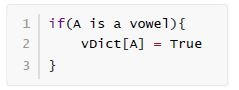
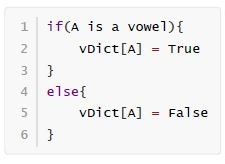
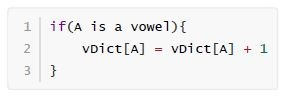
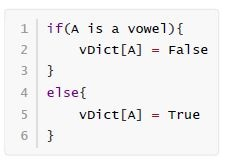
Correct answer
List of nouns that appear immediately after an adjective
List of adjectives that appear immediately after a noun
List of nouns that appear immediately before an adjective
List of adjectives that appear immediately before a noun
Correct answer
List of nouns that appear immediately after an adjective
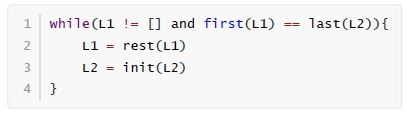
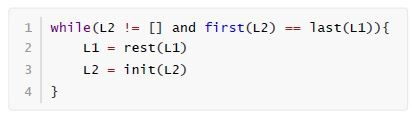
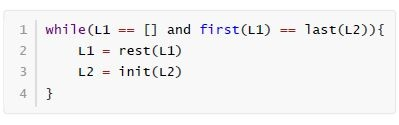
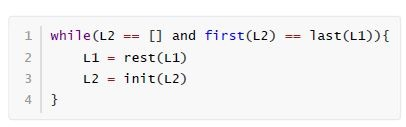
Correct answer
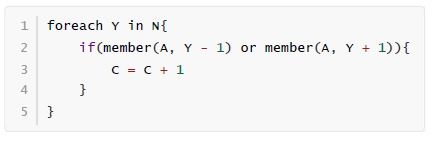
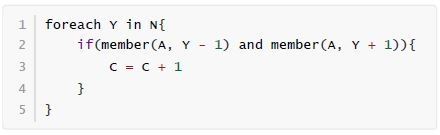
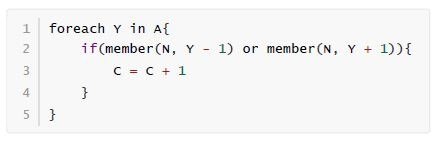
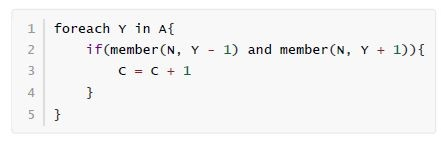
Correct answer
Let D be a dictionary, then which of the following is(are) a valid value(s) of D? It is a Multiple Select Question (MSQ).




Correct answers



Correct answer
Elements of Loi are in ascending order
Elements of Loi are in descending order
Elements of Loi are either in ascending or in descending order
Elements of Loi are neither in ascending nor in descending order
Correct answer
Elements of Loi are neither in ascending nor in descending order




Correct answer
Let Z.Word be "honesty". What will be the value of alphaDict['e'] at the end of the execution of the following pseudocode using the procedure mentioned in the main question?
Let Z.Word be "honesty". What will be the value of alphaDict['e'] at the end of the execution of the following pseudocode using the procedure mentioned in the main question? NOTE: Enter your answer to the nearest integer.
A written answer, not marked automatically.
The following pseudocode is executed using the "Words" dataset and the procedure updateDict mentioned in the main data.
The following pseudocode is executed using the "Words" dataset and the procedure updateDict mentioned in the main data. At the end of the execution of above pseudocode, let 'a' be a letter from the "Words" dataset, then D['a'] will be
The frequency count of 'a' in the dataset.
Number of words in which 'a' is present.
Number of sentences in which 'a' is present.
List of words in which 'a' is present.
Correct answer
The frequency count of 'a' in the dataset.
The following pseudocode is executed using the "Scores" dataset. At the end of the execution, medalList should store the list of sequence numbers of the students who have scored at least 200 total marks and have scored more than 80 at least in two subjects. Answer the given subquestions based on the pseudocode.
The following pseudocode is executed using the "Scores" dataset. At the end of the execution, medalList should store the list of sequence numbers of the students who have scored at least 200 total marks and have scored more than 80 at least in two subjects. Answer the given subquestions based on the pseudocode.
Which of the following statement(s) is(are) true about s200 based on the given pseudocode? It is a Multiple Select Question (MSQ).
s200 is a procedure which accepts the sequence number of a student andreturns True if the student has scored at least 200 total marks otherwise returns False.
s200 is a dictionary with sequence numbers of students mapped to True if thestudent has scored at least 200 total marks otherwise mapped to False.
s200 is a dictionary with sequence numbers of students mapped to False if thestudent has scored at least 200 total marks otherwise mapped to True.
s200 is a procedure which accepts the sequence number of a student andreturns False if the student has scored at least 200 total marks otherwise returns True.
Correct answer
s200 is a dictionary with sequence numbers of students mapped to True if thestudent has scored at least 200 total marks otherwise mapped to False.
The following pseudocode is executed using the "Scores" dataset. At the end of the execution, medalList should store the list of sequence numbers of the students who have scored at least 200 total marks and have scored more than 80 at least in two subjects. Answer the given subquestions based on the pseudocode.
The following pseudocode is executed using the "Scores" dataset. At the end of the execution, medalList should store the list of sequence numbers of the students who have scored at least 200 total marks and have scored more than 80 at least in two subjects. Answer the given subquestions based on the pseudocode.
Which of the following statement(s) is(are) true about nSub based on the given pseudocode? It is a Multiple Select Question (MSQ).
nSub is a procedure which accepts the sequence number of a student andreturns True if the student has scored more than 80 marks at least in two subjects otherwisereturns False.
nSub is a procedure which accepts the sequence number of a student andreturns the number of subjects in which the student has scored more than 80 marks.
nSub is a dictionary with sequence numbers of students mapped to thenumber of subjects in which the student has scored more than 80 marks.
nSub is a procedure which accepts the sequence number of a student andreturns False if the student has scored more than 80 marks at least in two subjects otherwisereturns True.
Correct answer
nSub is a procedure which accepts the sequence number of a student andreturns the number of subjects in which the student has scored more than 80 marks.
The following pseudocode is executed using the "Scores" dataset. At the end of the execution, medalList should store the list of sequence numbers of the students who have scored at least 200 total marks and have scored more than 80 at least in two subjects. Answer the given subquestions based on the pseudocode.
The following pseudocode is executed using the "Scores" dataset. At the end of the execution, medalList should store the list of sequence numbers of the students who have scored at least 200 total marks and have scored more than 80 at least in two subjects. Answer the given subquestions based on the pseudocode.
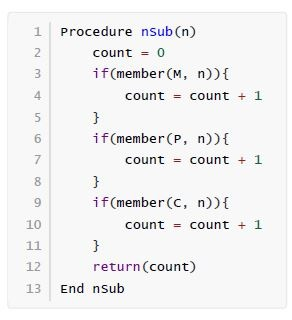
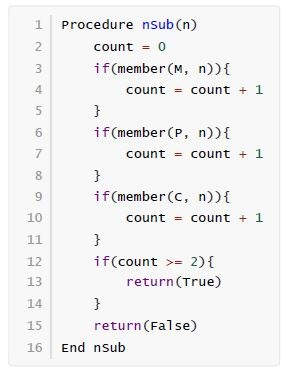
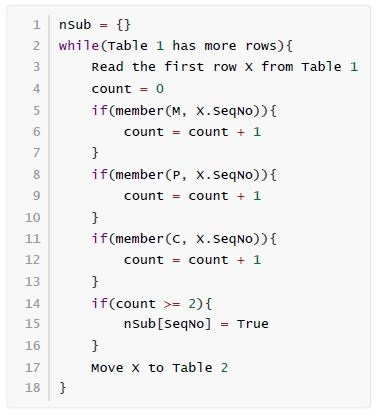
Let M, P, and C be the lists of the sequence numbers of the students who have scored more than 80 marks in Mathematics, Physics, and Chemistry respectively. If n is the sequence number of a student then choose the correct implementation of nSub?
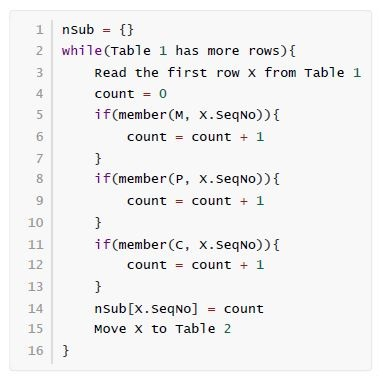
Correct answer
A written answer, not marked automatically.
The following pseudocode is executed using the "Scores" dataset. At the end of the execution, medalList should store the list of sequence numbers of the students who have scored at least 200 total marks and have scored more than 80 at least in two subjects. Answer the given subquestions based on the pseudocode.
The following pseudocode is executed using the "Scores" dataset. At the end of the execution, medalList should store the list of sequence numbers of the students who have scored at least 200 total marks and have scored more than 80 at least in two subjects. Answer the given subquestions based on the pseudocode.
A written answer, not marked automatically.